
5-Gallon Water Supply for Warehouses & Industrial Workplaces in UAE
A reliable 5-Gallon Water Supply in UAE helps warehouses, factories and industrial facilities maintain convenient access to drinking water for employees, supervisors and visitors. In workplaces with multiple departments, different shifts and large operational areas, managing drinking water requires more than keeping a few bottles in the office. Businesses need to consider workforce numbers, dispenser locations, bottle storage, consumption patterns and delivery schedules. Choosing a suitable commercial bottled drinking water supply service can help organisations arrange bulk orders and recurring deliveries according to their daily requirements.
From warehouse offices and staff rooms to production facilities, workshops, security cabins and maintenance areas, different workplace locations may have different water requirements.
A 5-gallon bottle, approximately 19 litres, can be a practical option for shared drinking-water facilities equipped with compatible dispensers or manual pumps. With the right stock and delivery plan, businesses can manage their supply without depending on frequent purchases of smaller bottles.
This guide explains how warehouse managers, facility supervisors, procurement teams and industrial businesses across the UAE can organise 5-gallon water orders, manage dispenser facilities and plan regular deliveries.
Quick Answer: Why Choose 5-Gallon Water Bottles for Industrial Workplaces?
Five-gallon bottled water can be suitable for warehouses and industrial facilities because it offers:
-
Larger capacity: Approximately 19 litres per bottle.
-
Dispenser compatibility: Suitable for shared drinking-water points.
-
Simplified stock management: Easier to monitor larger-volume bottles.
-
Recurring delivery: Businesses can plan replenishment according to consumption.
-
Multiple usage areas: Suitable for selected offices, staff rooms and rest areas.
-
Bottle collection arrangements: Empty bottles can be collected as part of recurring delivery plans where offered.
-
Flexible ordering: Quantities can be adjusted according to workforce and operational requirements.
The most suitable arrangement depends on the number of employees, available dispensers, facility layout and daily consumption.
Why Do Warehouses and Industrial Facilities Need a Planned Water Supply?
Warehouses and industrial workplaces operate differently from residential buildings and small offices.
Employees may work in different departments, shifts and locations throughout the facility. Some areas may have air-conditioned offices, while others include workshops, loading bays, production sections and warehouse floors.
A planned drinking-water supply helps businesses manage several operational requirements.
1. Employee Access Across Different Areas
Workers should be able to access drinking water without unnecessarily travelling from one end of the facility to another.
Larger warehouses may need separate water distribution points for administrative offices, staff rest areas and designated employee facilities.
2. Different Working Shifts
Facilities operating morning, evening or night shifts need to ensure that drinking-water stock is available throughout operating hours.
A delivery arrangement should account for all shifts rather than considering only daytime consumption.
3. Multiple Departments
A warehouse may have separate requirements for:
-
Warehouse operators.
-
Packaging and picking teams.
-
Loading and unloading staff.
-
Maintenance technicians.
-
Security personnel.
-
Administrative employees.
-
Supervisors and visitors.
Including these groups in the supply estimate gives procurement teams a more complete picture of demand.
4. Continuous Facility Operations
Some industrial workplaces operate for extended hours or across multiple shifts.
If drinking-water inventory is not monitored, a facility may run out before the next scheduled delivery.
Regular stock checks and planned replenishment help reduce this risk.
5. Better Facility Management
A centralised purchasing and distribution process makes it easier to track water usage, monitor empty bottles and coordinate deliveries across different departments.
What Is a 5-Gallon Water Bottle?
A 5-gallon water bottle holds approximately 19 litres of drinking water.
It is commonly used with compatible water dispensers and manual pumps in workplaces where several employees share a drinking-water facility.
Compared with smaller individual bottles, a 5-gallon format provides a larger volume in one container.
For warehouses and industrial facilities, this can be useful in locations such as:
-
Employee break rooms.
-
Administrative offices.
-
Supervisor cabins.
-
Security rooms.
-
Meeting areas.
-
Staff pantries.
-
Designated rest facilities.
The bottle should be used with suitable dispensing equipment and placed in an accessible location where employees can use it conveniently.
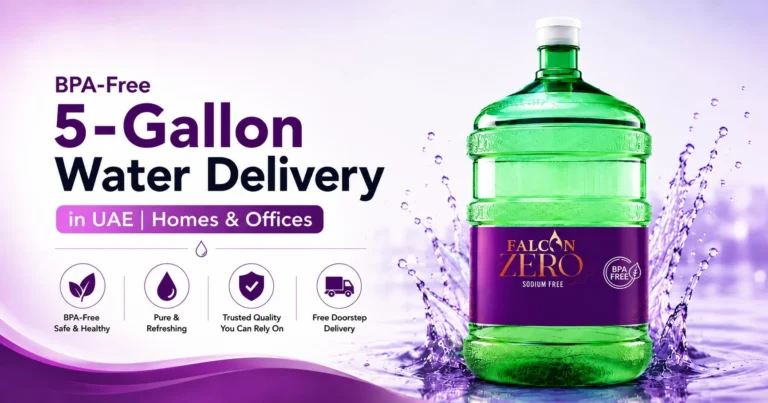
Falcon supplies 5-gallon bottled drinking water in BPA-free polycarbonate bottles and offers delivery arrangements for commercial facilities, including warehouses and industrial workplaces.
Falcon+1
Where Should You Place 5-Gallon Water Dispensers in a Warehouse?
Dispenser placement is an important part of workplace water management.
Even when sufficient bottled water is available, poor placement can make it difficult for employees to access the supply.
The facility layout should guide the number and location of dispensers.
1. Staff Break Rooms
Break rooms are practical locations for shared drinking-water facilities.
Employees can access water during scheduled breaks without interfering with warehouse operations.
2. Warehouse Administration Offices
Administrative teams, supervisors and procurement staff may require a separate dispenser within their office area.
3. Security Cabins
Facilities with security personnel working extended shifts may benefit from a dedicated drinking-water point.
4. Maintenance Workshops
Technicians and maintenance staff may need convenient access to drinking water near their designated rest facilities.
The dispenser should be placed away from chemicals, oils, workshop contaminants and equipment movement.
5. Industrial Staff Facilities
Factories and industrial buildings may have designated employee facilities where dispensers can be installed.
6. Separate Floors and Buildings
If a workplace operates across multiple floors or separate buildings, consider the distance between facilities before deciding how many dispensers are required.
Important: Do not place dispensers in forklift routes, loading zones, emergency exits or areas where bottles could obstruct movement. Choose stable, accessible locations with sufficient space for bottle replacement.
How to Choose the Right Water Dispenser for a Warehouse
The dispenser is an important part of a 5-gallon water supply arrangement.
Before purchasing or installing one, consider how many employees will use it, where it will be positioned and how frequently bottles will need replacement.
Top-Loading Water Dispensers
Top-loading dispensers hold the bottle above the dispensing unit.
Suitable for:
-
Small warehouse offices.
-
Staff rooms.
-
Supervisor cabins.
-
Facilities with limited installation requirements.
The bottle is visible and can be replaced when empty.
Bottom-Loading Water Dispensers
Bottom-loading dispensers position the bottle inside the lower compartment.
Suitable for:
-
Office areas.
-
Meeting rooms.
-
Reception spaces.
-
Facilities where easier bottle handling is preferred.
The bottle is less visible, and the design avoids lifting a heavy full bottle onto the top of the unit. The manufacturer’s operating instructions should still be followed when replacing bottles.
Manual Water Pumps
Manual pumps can provide an alternative where an electrical dispenser is not required.
They may be useful for selected low-usage locations, subject to hygienic handling and cleaning arrangements.
Falcon offers hot and cold water dispensers and water pumps for large bottles for different workplace requirements.
Falcon Bottled Water+1
| Dispenser Type | Possible Workplace Application |
|---|---|
| Top-loading | Staff rooms and small offices |
| Bottom-loading | Administrative offices and meeting areas |
| Manual pump | Selected areas without a dispenser |
| Hot and cold dispenser | Offices and shared staff facilities |
Before selecting equipment, confirm bottle compatibility, available space, power requirements and maintenance instructions.
How to Calculate 5-Gallon Water Requirements for Your Workplace
One of the most important parts of planning a commercial water supply is estimating how many bottles the facility needs.
Ordering too little can lead to stock shortages, while ordering too much can occupy valuable storage space.
The quantity should be based on actual consumption rather than an arbitrary number of bottles per employee.
Step 1: Calculate the Number of Employees
Start with the number of people regularly using the facility.
Include:
-
Warehouse employees.
-
Production workers.
-
Administrative teams.
-
Maintenance staff.
-
Security personnel.
-
Supervisors.
-
Regular visitors and contractors.
Step 2: Consider Working Shifts
A facility with 100 employees on one shift may have a different dispenser requirement from a facility with 100 employees distributed across three shifts.
Record the number of employees working during each operating period.
Step 3: Count the Available Dispensers
List the dispensers currently installed across the facility.
Record the location and estimated usage of each unit.
This helps identify which areas require more frequent replenishment.
Step 4: Review Actual Bottle Consumption
Track the number of full bottles delivered and empty bottles returned.
This is one of the simplest methods of estimating actual consumption.
For example, if a warehouse consistently uses 30 bottles per week, that historical figure provides a starting point for the next order.
Step 5: Include Additional Requirements
Consumption may increase because of:
-
New employees.
-
Additional working shifts.
-
Temporary contractors.
-
Extended operating hours.
-
New warehouse sections.
-
Maintenance activities.
-
Special operational requirements.
Include these changes when preparing the next order.
Example: Monthly 5-Gallon Water Planning
Consider an industrial facility with six dispensers.
After monitoring its stock records, the facility estimates that each dispenser uses approximately two bottles per working day.
For a 22-day working month:
| Planning Detail | Quantity |
|---|---|
| Number of dispensers | 6 |
| Average bottles per dispenser per day | 2 |
| Working days | 22 |
| Estimated monthly consumption | 264 bottles |
Calculation:
6 × 2 × 22 = 264 bottles per month
These are illustrative figures, not a recommended consumption rate. Actual requirements should be determined through bottle replacement records and workplace usage.
The facility should also account for existing stock and an appropriate reserve when confirming the final order.
How to Plan 5-Gallon Water Supply in UAE for Multiple Departments
For larger facilities, water supply should be managed as a shared operational requirement.
Rather than allowing each department to order bottles independently, procurement teams can maintain a central record of consumption and replenishment.
This creates a clearer picture of total demand.
Create Department-Wise Usage Records
For example:
| Department | Dispensers | Weekly Bottle Usage |
|---|---|---|
| Administration | 2 | 10 |
| Warehouse operations | 3 | 24 |
| Maintenance | 1 | 7 |
| Security | 1 | 5 |
| Staff facilities | 2 | 14 |
The quantities above are illustrative.
Department-wise records help identify where the highest consumption occurs and whether additional dispensers or more frequent replenishment are required.
Assign a Responsible Person
Identify someone in each department who can monitor the remaining bottles and report when replenishment is needed.
Maintain a Central Procurement Record
The purchasing team should keep one record containing:
-
Total dispensers.
-
Available full bottles.
-
Empty bottles awaiting collection.
-
Weekly consumption.
-
Next delivery date.
-
Supplier contact details.
-
Special delivery instructions.
Review Changes in Usage
If a new team joins or another warehouse section becomes operational, update the forecast.
This reduces the likelihood of ordering based on outdated consumption figures.
How to Arrange Regular 5-Gallon Bottle Deliveries
A scheduled delivery plan can help warehouses maintain sufficient stock without placing repeated emergency orders.
The frequency should depend on actual consumption, storage capacity and supplier availability.
Daily Deliveries
Daily replenishment may be suitable for facilities with high consumption or limited storage space, where the supplier offers this arrangement.
Weekly Deliveries
Weekly delivery can be practical for warehouses with predictable usage and sufficient storage capacity.
Bi-Weekly Deliveries
A bi-weekly schedule may suit smaller facilities or locations with lower consumption, provided their available stock can cover the delivery interval.
Falcon states that it offers daily, weekly and bi-weekly delivery schedules for commercial 5-gallon customers, based on consumption requirements.
Falcon+1
Set a Reorder Point
A reorder point helps the facility know when to request additional bottles.
A simple formula is:
Reorder point = Expected bottle usage during supplier lead time + Reserve stock
For example, if a facility uses 8 bottles per working day and its next delivery requires two working days, it needs to consider 16 bottles to cover that period, before adding a suitable reserve.
This calculation should be based on actual consumption and confirmed supplier lead times.
How Should Warehouses Store 5-Gallon Water Bottles?
Storage conditions are important for managing bottled water in warehouses and industrial facilities.
A large bottle inventory needs a designated area that protects the packaging and allows employees to handle deliveries safely.
Choose a Clean Storage Location
Keep drinking-water stock separate from chemicals, oils, fuel, cleaning products and industrial materials.
The storage area should be clean and suitable for bottled drinking water.
Avoid Direct Sunlight and Excessive Heat
Keep bottles away from prolonged sunlight and excessive heat.
Follow the supplier’s storage instructions and select a suitable protected area.
Use Stable Storage Arrangements
Place bottles upright on a stable surface or appropriate storage racks.
Avoid arrangements that could cause bottles to fall, become damaged or obstruct workers.
Protect Bottles From Contamination
Keep caps and seals intact until the bottle is ready for use.
Do not store full bottles near waste-handling areas or locations exposed to dust and industrial contaminants.
Organise Stock by Delivery Date
Use a first-in, first-out approach where appropriate.
This helps ensure that older stock is used before newer deliveries.
Keep Storage Accessible
Ensure that employees responsible for handling bottles can move stock without entering hazardous work zones or blocking emergency access.
How to Maintain Water Dispensers in Industrial Workplaces
A regular water supply plan should include dispenser cleaning and maintenance.
Even when bottled water arrives in sealed containers, the dispensing equipment needs appropriate care.
Clean the Dispenser Regularly
Follow the dispenser manufacturer’s cleaning instructions and establish a documented maintenance schedule.
Keep the Dispensing Area Clean
Remove spills and maintain cleanliness around the dispenser.
Check Taps and Components
Inspect taps, connections and other accessible components for visible damage or leakage.
Follow Proper Bottle Replacement Procedures
Employees responsible for changing bottles should follow the equipment instructions and maintain hygienic handling practices.
Avoid Shared Drinking Cups
Provide individual drinking vessels or another suitable arrangement rather than common shared cups.
Workplace compliance note: In Abu Dhabi, ADOSH-SF Code of Practice 8.0 specifically requires employers to provide accessible drinking water at appropriate locations and states that drinking-water dispensers must be cleaned daily. It also prohibits common or shared drinking cups and bottles. Businesses should follow the relevant requirements applicable to their emirate and workplace.
What Should Businesses Check Before Choosing a 5-Gallon Water Supplier?
A suitable supplier should be able to support the facility’s consumption, delivery and bottle-handling requirements.
Before placing a recurring commercial order, consider the following factors.
1. Bottle Quality and Specifications
Confirm the bottle material, capacity, packaging and product details.
For reusable 5-gallon bottles, understand the supplier’s handling and collection process.
2. Product Information
Ask for information about the bottled drinking water, applicable product standards and the supplier’s quality-control processes.
3. Delivery Coverage
Check whether the supplier serves the exact warehouse or industrial location.
Facilities in different emirates may have different delivery arrangements.
4. Delivery Frequency
Confirm whether daily, weekly or bi-weekly delivery is available for your required quantity and location.
5. Empty Bottle Collection
For recurring orders, check how empty bottles are collected and exchanged.
Falcon’s product information states that empty bottles are collected during scheduled deliveries for recurring customers, subject to its collection arrangements.
6. Dispenser Compatibility
Make sure the bottles work with your existing water dispensers or manual pumps.
7. Commercial Pricing
Request a quotation that clearly explains:
-
Bottle price.
-
Minimum order quantity.
-
Delivery charges, if applicable.
-
Refundable bottle deposit.
-
Payment terms.
-
Empty-bottle return conditions.
8. Customer Support
Confirm how to place orders, change delivery quantities and report issues with an order.
For larger facilities, having one contact for recurring supply coordination can simplify procurement.
Understanding the 5-Gallon Bottle Deposit and Return Process
Reusable 5-gallon bottles often involve a deposit and exchange arrangement.
Businesses should understand these terms before beginning a recurring supply plan.
For example, Falcon’s current product information states that a refundable deposit is charged for each 5-gallon bottle delivered. Depending on the selected plan, the charge generally appears on the first invoice. The deposit is refundable upon return of empty bottles, subject to the stated invoice requirements.
Falcon – Trusted Supplier Since 1995
For a warehouse or industrial workplace, this means the purchasing team should establish a process for:
-
Recording the number of bottles received.
-
Tracking empty bottles.
-
Keeping the relevant delivery records or coupons.
-
Storing empties at the agreed collection point.
-
Checking bottle quantities during each delivery.
-
Reviewing deposit and return details with the supplier.
This helps prevent confusion when several departments use the same bottle supply arrangement.
Common Mistakes to Avoid When Managing 5-Gallon Water Supply
Ordering Without Checking Consumption
An estimated quantity that does not reflect actual usage can result in shortages or unnecessary stock.
Installing Too Few Dispensers
A single dispenser may not be convenient for a large facility with multiple departments and floors.
Keeping Bottles in Unsuitable Areas
Direct sunlight, excessive heat, chemicals and industrial contamination can affect storage conditions.
Ignoring Empty Bottle Collection
Without a clear collection process, empty bottles can accumulate and occupy valuable warehouse space.
Not Monitoring Night Shifts
Facilities operating multiple shifts should ensure that the water supply covers all working periods.
Using Incompatible Dispensers
Check bottle compatibility before placing a recurring order or buying new dispensing equipment.
Forgetting Dispenser Maintenance
A regular bottle supply does not eliminate the need for dispenser cleaning and maintenance.
Failing to Review Delivery Schedules
Consumption may change as the workforce or facility operations change. Review schedules periodically rather than relying on the original order quantity indefinitely.
How Falcon Supports 5-Gallon Water Supply for UAE Workplaces
Warehouses and industrial facilities often need a supplier that can manage large-volume bottles, recurring delivery arrangements and empty-bottle collection.
Falcon Bottled Water supplies 5-gallon bottled drinking water to warehouses, industrial facilities, commercial buildings and other workplaces across the UAE.
Its current service information includes:
-
Approximately 19-litre bottled water.
-
BPA-free polycarbonate bottles.
-
Compatibility with standard water dispensers and manual pumps.
-
Daily, weekly and bi-weekly delivery arrangements.
-
Empty-bottle collection for recurring customers.
- Delivery coverage across all seven UAE emirates.
For businesses planning a regular supply, the procurement team can discuss:
-
Warehouse or facility location.
-
Number of employees.
-
Number of dispensers.
-
Estimated weekly bottle consumption.
-
Required delivery frequency.
-
Empty-bottle collection arrangements.
-
Commercial pricing and order requirements.
Explore Falcon’s 5-gallon bottled drinking water supply to discuss a suitable delivery arrangement for your warehouse or industrial workplace.
Practical 5-Gallon Water Supply Checklist for Businesses
Before confirming your commercial order, review the following.
Workplace Requirements
Product and Equipment
Storage
Delivery
Commercial Terms
Frequently Asked Questions
What is the capacity of a 5-gallon water bottle?
A standard 5-gallon bottle used for drinking-water delivery holds approximately 19 litres. It is commonly used with compatible water dispensers and manual pumps.
Are 5-gallon water bottles suitable for warehouses?
Yes. They can be useful in warehouse offices, staff rooms, break areas, supervisor cabins and other suitable facilities where employees share drinking-water dispensers.
How many 5-gallon bottles does an industrial workplace need?
The quantity depends on employee numbers, working shifts, dispenser usage and actual consumption. Recording empty-bottle returns and delivery quantities can help establish a reliable weekly estimate.
How often should businesses order 5-gallon bottled water?
It depends on consumption and storage capacity. Some workplaces may need daily replenishment, while others can use weekly or bi-weekly deliveries.
Can 5-gallon bottles be used with hot and cold water dispensers?
Yes, where the bottles are compatible with the selected dispenser. Check the equipment and bottle specifications before ordering.
Are 5-gallon polycarbonate bottles reusable?
Reusable polycarbonate bottles are designed for repeated use under the supplier’s return, inspection and sanitisation procedures. Follow the supplier’s instructions for bottle exchange and handling.
Does Falcon collect empty 5-gallon bottles?
Falcon states that empty bottles are collected during scheduled deliveries for recurring customers, according to its collection arrangements.
Is there a deposit for 5-gallon water bottles?
Falcon’s current product information states that a refundable deposit applies to 5-gallon bottles, subject to its invoice and empty-bottle return conditions. Confirm the current terms when placing an order.
Does Falcon deliver 5-gallon water to warehouses and industrial facilities?
Falcon lists warehouses and industrial facilities among its commercial customer segments and states that it delivers across all seven UAE emirates. Confirm availability for your exact facility location.
What should I consider before arranging bulk 5-gallon delivery?
Consider the number of employees, dispenser count, weekly consumption, storage capacity, delivery access, bottle exchange arrangements and commercial terms.