Sodium-Free Bottled Drinking Water in the UAE: What Buyers Should Know Before Choosing a Product
Choosing the right bottled drinking water involves more than checking its taste, packaging or brand. For consumers who pay attention to mineral composition and dietary sodium intake, understanding the sodium level in drinking water can be an important part of the buying decision. With different bottled water products available across the UAE, knowing how to compare their specifications helps buyers make informed choices.
Sodium is a naturally occurring mineral found in water and many foods. Its concentration can vary depending on the original water source and the purification process. While some consumers prefer regular bottled drinking water, others specifically look for sodium-free bottled drinking water in the UAE because of their personal dietary preferences or healthcare guidance.
But what does sodium-free actually mean? Is it the same as low-sodium water? Does reverse osmosis remove sodium? And what should buyers check before selecting a bottled water product?
This guide explains sodium content, water mineral composition, purification methods, packaging considerations and important factors to evaluate when purchasing bottled drinking water for homes, offices and businesses across the UAE.
What Is Sodium-Free Bottled Drinking Water?
Sodium-free bottled drinking water refers to water marketed as containing no sodium or a negligible amount according to its verified product specification and applicable labelling requirements.
Sodium is a mineral that can naturally occur in water when it comes into contact with soil, rocks and underground geological formations. Its concentration varies depending on the source and treatment process.
Unlike flavoured beverages and many processed drinks, plain drinking water does not require added sugar, flavouring or sweeteners. However, it may contain naturally occurring dissolved minerals, including:
- Sodium
- Calcium
- Magnesium
- Potassium
- Chloride
- Bicarbonate
A sodium-free product is therefore best evaluated through its declared mineral composition and laboratory analysis rather than relying exclusively on the wording printed on the bottle.
For buyers, the key consideration is understanding how much sodium the product actually contains and whether its specifications match their requirements.
Why Does Sodium Content Matter When Choosing Drinking Water?
Sodium is an essential electrolyte that supports normal body functions, including fluid balance, nerve signalling and muscle activity.
However, excessive sodium intake is associated with increased blood pressure and cardiovascular health risks. The World Health Organization recommends that adults consume less than 2,000 mg of sodium per day, equivalent to less than 5 grams of salt.
Although most dietary sodium comes from food choices, drinking water can also contribute to overall sodium intake depending on its mineral composition.
This is why some buyers consider sodium levels when selecting bottled water.
People may look for lower-sodium drinking water for several reasons:
- Personal dietary preferences.
- Monitoring overall sodium consumption.
- Following healthcare professional recommendations.
- Comparing the mineral composition of different bottled water brands.
- Choosing water with a particular dissolved-mineral profile.
It is important to remember that sodium-free water is not a treatment for high blood pressure, kidney disease or heart conditions. People following medically prescribed sodium restrictions should consider their total dietary intake and consult their healthcare professional.
Sodium-Free vs Low-Sodium vs Regular Bottled Drinking Water
One common misunderstanding among buyers is assuming that sodium-free and low-sodium water mean exactly the same thing.
These descriptions refer to different sodium-content claims and should be evaluated using the product’s actual composition.
| Water description | What buyers should understand |
|---|---|
| Sodium-free water | Marketed as having no or negligible sodium, supported by product specifications |
| Low-sodium water | Contains a relatively low amount of sodium compared with relevant alternatives |
| Regular bottled water | May contain naturally occurring sodium and other dissolved minerals |
| Purified drinking water | Treated to remove impurities and dissolved substances, depending on the treatment system |
There is an important distinction between sodium-free water and water with no added sodium.
Water that has not had sodium added during processing may still contain naturally occurring sodium from its source.
Therefore, buyers should check the declared sodium concentration rather than assuming that the absence of added sodium means the product contains zero sodium.
How to Check Sodium Levels on Bottled Water Labels
Reading the water label is one of the easiest ways to compare bottled drinking water products.
In the UAE, bottled drinking water labelling follows applicable Gulf technical requirements, including GSO 2232:2021. Abu Dhabi’s published food-labelling guidance also identifies sodium among the mineral composition details for bottled drinking water under UAE.S GSO 1025:2014.
When comparing water products, look for the following information.
1. Sodium Content (mg/L)
Sodium concentration is commonly expressed in milligrams per litre (mg/L).
For example, a water analysis might show:
| Mineral | Illustrative concentration |
|---|---|
| Sodium | 0 mg/L |
| Calcium | 2 mg/L |
| Magnesium | 1 mg/L |
| Potassium | 0.5 mg/L |
| Total Dissolved Solids | 10 mg/L |
A product showing a lower sodium concentration may be more suitable for a buyer specifically comparing sodium content.
However, check whether the stated value is a measured result, a rounded figure or a result below the laboratory’s reporting limit.
2. Total Dissolved Solids (TDS)
TDS represents the combined concentration of dissolved substances in water.
It can include dissolved mineral salts such as sodium, calcium, magnesium and other inorganic substances.
However, TDS is not a direct measurement of sodium.
Two bottled water products may have similar TDS readings but different sodium concentrations because their mineral compositions can vary.
Therefore, buyers should examine the sodium value separately instead of using TDS as the only selection factor.
3. pH Level
pH indicates whether water is acidic, neutral or alkaline.
It is another useful specification to understand when comparing bottled water products.
However, pH and sodium concentration measure different properties. A higher or lower pH does not automatically indicate that water contains more or less sodium.
4. Mineral Composition
Review the complete mineral profile where available.
Calcium, magnesium, potassium and bicarbonate contribute to the overall dissolved-mineral composition and can influence the water’s taste and characteristics.
For buyers comparing sodium-free bottled water, reviewing the full composition provides more useful information than looking at a single marketing claim.
5. Product Testing and Quality Information
Check whether the manufacturer provides laboratory test reports, product specifications and relevant certifications.
For commercial buyers, documented test results and batch traceability can make product evaluation easier.
How Does the Purification Process Affect Sodium Levels?
The purification method used during bottled water production can influence the final sodium concentration.
Different treatment technologies are designed to address different types of impurities. Understanding these processes helps consumers evaluate the information provided by bottled water manufacturers.
1. Reverse Osmosis (RO) Filtration
Reverse osmosis is a membrane-based water treatment process that uses pressure to separate water from many dissolved substances.
It can reduce dissolved salts, including sodium, depending on membrane performance and system operating conditions.
RO is commonly used in purified drinking water production because it can reduce several dissolved impurities and improve water consistency.
However, the final sodium concentration depends on the treatment system, membrane condition, water quality and any subsequent blending or mineral adjustment.
Therefore, the presence of an RO system alone does not prove that the finished product is completely sodium-free.
2. Activated Carbon Filtration
Activated carbon filtration is commonly used to reduce chlorine, unpleasant odours and certain organic compounds.
It helps improve the taste and general characteristics of drinking water.
However, conventional activated carbon filtration is not designed to remove dissolved sodium ions.
3. UV Sterilisation
Ultraviolet treatment uses UV light to inactivate microorganisms, including certain bacteria and viruses.
It is a disinfection method rather than a dissolved-mineral removal process.
UV treatment does not remove sodium from water, so it should not be considered a sodium-reduction technology.
4. Final Quality Testing
After purification, the water should undergo appropriate quality checks before bottling.
Depending on the product and applicable quality requirements, testing can cover:
- Sodium concentration.
- Total dissolved solids.
- pH levels.
- Microbiological parameters.
- Other chemical and physical characteristics.
This helps verify that the finished bottled drinking water meets its intended product specifications.
Purified Drinking Water vs Natural Mineral Water: Which Should Buyers Choose?
Another important consideration when purchasing sodium-free bottled drinking water is understanding the difference between purified water and natural mineral water.
Although both are available as bottled products, they have different sources, processing requirements and mineral characteristics.
| Feature | Purified Drinking Water | Natural Mineral Water |
|---|---|---|
| Source | Suitable water treated for drinking | Protected underground source |
| Processing | May involve RO, filtration and disinfection | Only permitted treatments |
| Mineral composition | Depends on source and treatment | Naturally occurring and relatively stable |
| Sodium level | Depends on source and purification | Depends on natural source composition |
| Buyer consideration | Check treatment details and final analysis | Check the declared mineral composition |
The GSO standards distinguish treated bottled drinking water from natural mineral water obtained from underground sources with a stable mineral composition.
For buyers specifically looking for low-sodium or sodium-free water, neither category should be selected based on its name alone.
The actual sodium concentration must be checked before making a decision.
What Should Buyers Consider Before Purchasing Sodium-Free Bottled Water in the UAE?
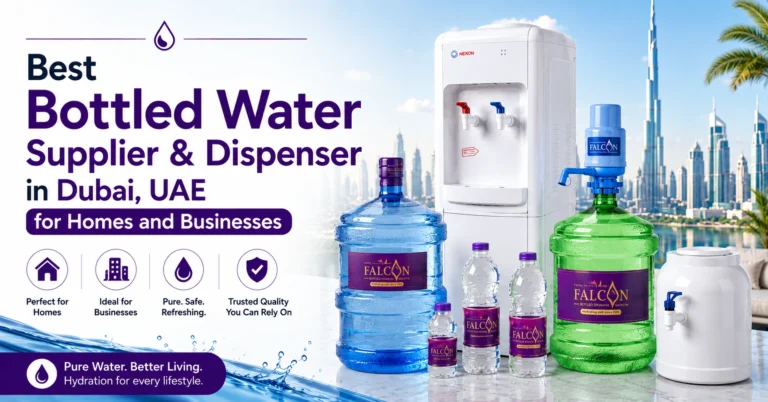
The UAE bottled water market offers products in different packaging formats and sizes for households, offices, hospitality businesses and commercial facilities.
Before purchasing, consider these factors.
1. Verify the Actual Sodium Concentration
Look for the sodium value in mg/L and confirm it through the available product analysis.
Do not rely only on terms such as pure, light or mineral-balanced, as these do not independently establish sodium concentration.
2. Understand the Purification Technology
Review whether the manufacturer uses reverse osmosis, carbon filtration, UV treatment or other applicable purification methods.
The treatment process should be supported by information about the finished product’s actual quality.
3. Check Bottle Material and Packaging
Packaging is another consideration when purchasing bottled drinking water.
Look for properly sealed, food-grade containers and clear product identification.
For larger water bottles, check whether the packaging is compatible with the intended dispenser or pump.
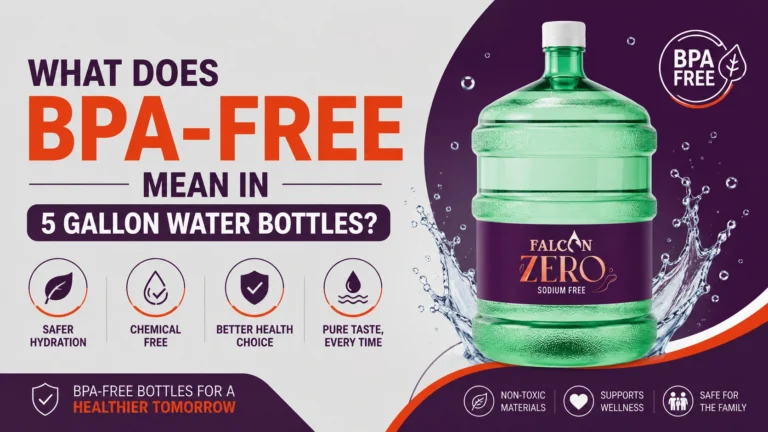
BPA-free packaging is a separate consideration from sodium concentration. It relates to the packaging material, not the mineral content of the water.
4. Review Storage and Handling Conditions
Proper storage helps maintain bottled water quality.
Consider:
- Keeping bottles away from direct sunlight.
- Avoiding unnecessary exposure to excessive heat.
- Checking the cap and seal before use.
- Following the manufacturer’s storage instructions.
- Using clean dispensers and regularly maintained equipment.
These practices are particularly relevant for households and businesses storing multiple 5-gallon bottles.
5. Consider Bottle Sizes and Consumption Requirements
Different customers have different drinking water requirements.
For example:
- 250 ml bottles may suit meetings and small hospitality requirements.
- 500 ml bottles are convenient for everyday individual consumption.
- 5-gallon bottles are practical for household and office dispensers.
Choosing the appropriate quantity and bottle size helps businesses and households manage their regular water requirements.
6. Check Supplier Reliability and Delivery Coverage
For regular bottled drinking water purchases, buyers should also consider delivery availability, ordering convenience and supply consistency.
Businesses such as offices, restaurants, hotels, schools and healthcare facilities may require scheduled deliveries based on their consumption.
A supplier with suitable delivery coverage and clearly defined ordering arrangements can make regular water supply easier to manage.
Why Choose Sodium-Free Bottled Drinking Water from Falcon?
Falcon Bottled Drinking Water has been serving households and businesses across the UAE since 1995.
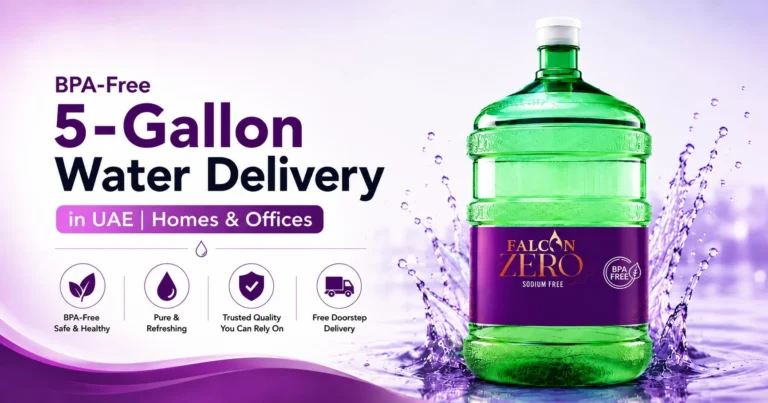
The company offers different bottled water options, including a 5-gallon BPA-free sodium-free drinking water product, alongside its regular bottled drinking water range.
Falcon’s purification information includes reverse osmosis, filtration and UV sterilisation as part of its water treatment approach.
For buyers comparing sodium-free bottled water, the following product considerations are relevant:
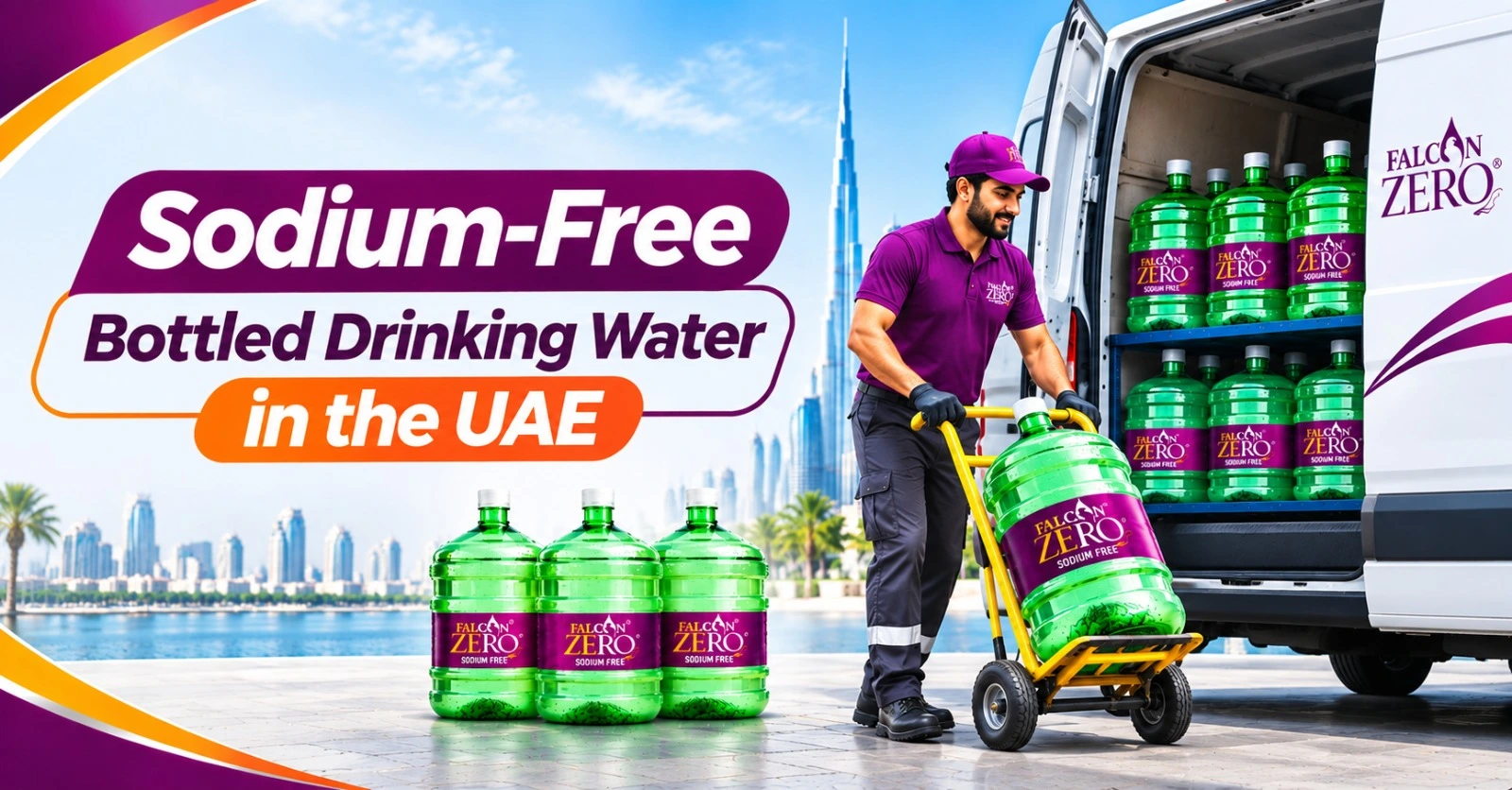
Sodium-free water option: Falcon lists a 5-gallon sodium-free drinking water product for customers looking for this specification.
BPA-free packaging: The listed 5-gallon option uses BPA-free bottle packaging.
Purification process: Falcon describes its use of RO filtration and UV treatment as part of its purified drinking water process.
Different bottle sizes: The product range includes 250 ml, 500 ml and 5-gallon options.
UAE-wide delivery: Falcon serves residential and commercial customers across Dubai, Abu Dhabi, Sharjah, Ajman, Ras Al Khaimah, Fujairah and Umm Al Quwain.
For specific sodium restrictions, customers should request the latest product composition or laboratory analysis for the exact product they intend to purchase.
Businesses and households can explore Falcon’s bottled drinking water range to review available options.
Sodium-Free Bottled Water for Homes, Offices and Commercial Businesses
Different customers have different requirements when selecting bottled drinking water.
A suitable product range should accommodate both individual hydration needs and larger commercial consumption.
Residential Use
Families may prefer convenient bottle sizes for daily household consumption.
A 5-gallon bottle can be used with a compatible dispenser, while smaller bottles are suitable for individual use and travel.
Office Environments
Offices often require a regular supply of drinking water for employees, visitors and meeting rooms.
Larger bottles can support shared dispensers, reducing the need to manage numerous smaller bottles.
Hotels and Hospitality Businesses
Hotels, restaurants and hospitality establishments may require smaller bottled water formats for guest rooms, dining areas, conferences and events.
Product selection can depend on serving requirements, packaging preferences and daily consumption.
Schools and Educational Institutions
Educational facilities may require a consistent supply of bottled drinking water for students, teachers and administrative staff.
Bottle sizes, storage arrangements and delivery frequency should be considered when planning supply.
For all these settings, sodium content should be evaluated alongside the product’s overall quality, regulatory compliance and handling requirements.
Common Mistakes to Avoid When Buying Sodium-Free Drinking Water
Even when a bottled water product is marketed as sodium-free, buyers should verify its actual specifications.
Avoid these common mistakes:
Assuming sodium-free means absolutely zero: Check the measured value and laboratory reporting limits before interpreting a zero claim.
Confusing no added sodium with sodium-free: Naturally occurring sodium may still be present.
Using TDS as the only selection factor: TDS does not identify the exact amount of sodium.
Ignoring the water source: Purified and natural mineral water have different characteristics.
Assuming UV treatment removes sodium: UV treatment is intended for disinfection, not dissolved mineral removal.
Choosing based only on packaging: Bottle design and BPA-free materials do not determine the mineral composition of water.
Ignoring storage conditions: Direct sunlight, excessive heat and poor dispenser hygiene should be avoided.
Making an informed comparison helps buyers select bottled water based on actual product specifications rather than marketing descriptions.
Conclusion
Choosing sodium-free bottled drinking water in the UAE requires understanding more than a product label. Sodium concentration, mineral composition, purification technology, packaging and supplier information all contribute to an informed buying decision.
For consumers comparing bottled water products, checking the sodium value in mg/L and reviewing available laboratory information are important steps. Understanding the difference between purified drinking water and natural mineral water also helps clarify how the water’s composition is determined.
Whether purchasing bottled water for home, office or commercial use, buyers should compare product specifications and verify relevant quality information before choosing.
Falcon Bottled Drinking Water offers a range of bottled water products, including its 5-gallon BPA-free sodium-free option, with delivery services across the UAE.
Explore the available products and choose a bottled drinking water option that matches your requirements.
Frequently Asked Questions (FAQs)
1. What is sodium-free bottled drinking water?
Sodium-free bottled drinking water is marketed as containing no or negligible sodium, based on its product specifications and applicable labelling requirements. Buyers should check the actual sodium concentration and laboratory analysis.
2. Is sodium-free water better than regular bottled water?
Not necessarily. Both can be suitable drinking water products when they meet the applicable safety and quality requirements. The choice depends on individual preferences, mineral composition and any healthcare-related dietary recommendations.
3. How can I check the sodium level in bottled water?
Check the product label or mineral composition report for sodium content, usually expressed in milligrams per litre (mg/L). You can also request the latest laboratory analysis from the manufacturer.
4. Does reverse osmosis remove sodium from drinking water?
Yes. Reverse osmosis can reduce dissolved sodium ions and other dissolved substances. However, the final sodium concentration depends on system performance, membrane condition and subsequent treatment.
5. Does UV purification remove sodium?
No. UV treatment is primarily used to inactivate microorganisms. It does not remove dissolved sodium or other mineral salts.
6. What is the difference between sodium-free and low-sodium water?
Sodium-free water is marketed as containing no or negligible sodium, whereas low-sodium water contains a relatively low amount. Always compare the actual mineral composition instead of relying solely on product descriptions.
7. Does TDS indicate the amount of sodium in drinking water?
No. TDS measures the total concentration of dissolved substances, including different minerals and salts. Sodium must be measured or reported separately.
8. Is sodium-free water suitable for people following a low-sodium diet?
It may be one option for people managing dietary sodium intake. However, total sodium consumption from food and beverages matters. People with medical restrictions should follow their healthcare professional’s advice.
9. What is the difference between purified water and natural mineral water?
Purified drinking water undergoes treatment to remove impurities, while natural mineral water comes from protected underground sources and retains a relatively stable natural mineral composition. Their sodium levels can vary.
10. Does Falcon offer sodium-free bottled drinking water in the UAE?
Yes. Falcon lists a 5-gallon BPA-free sodium-free drinking water option, alongside other bottled water products. Customers can contact Falcon to confirm the latest product specifications and delivery availability.