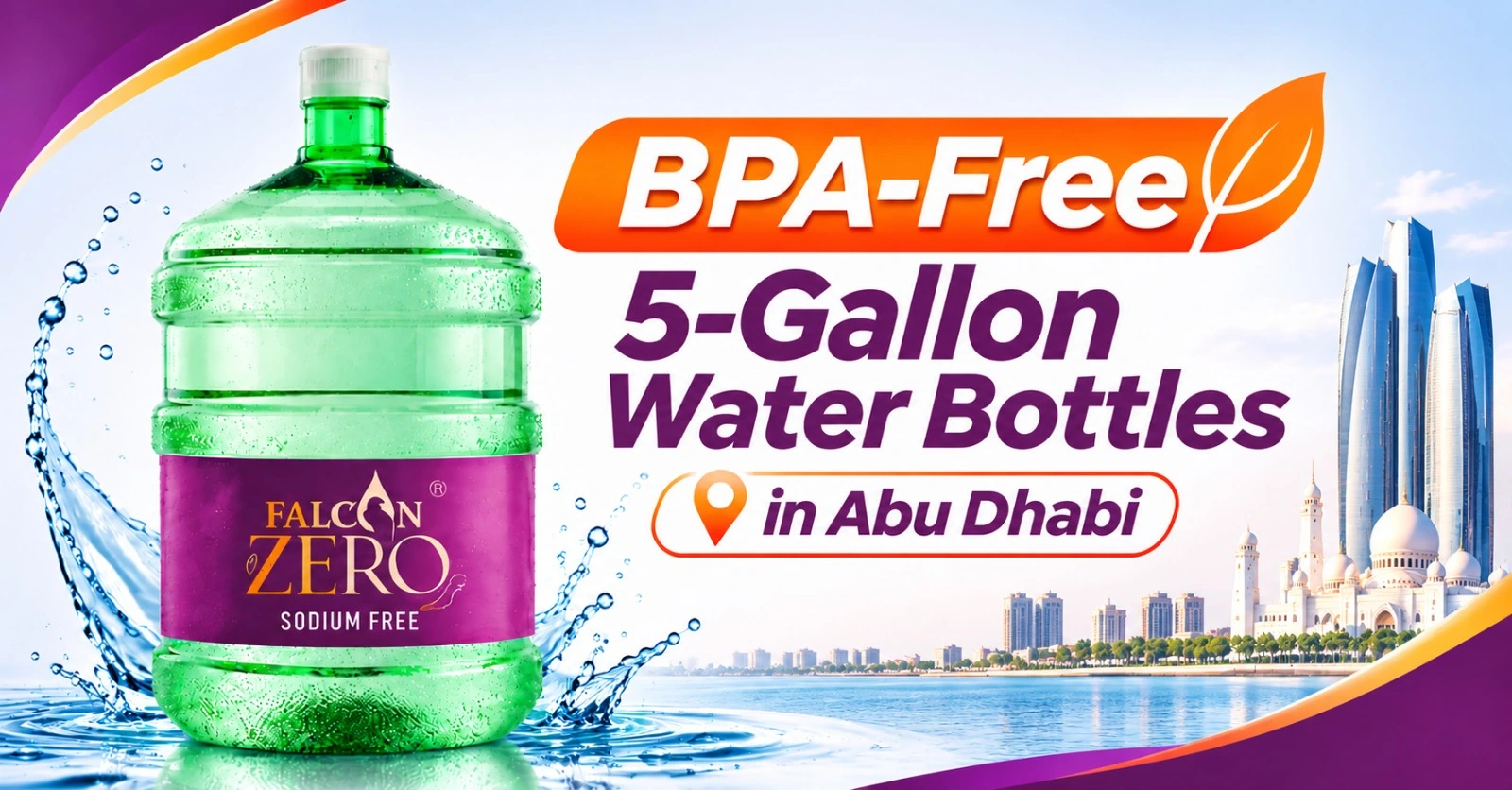
BPA-Free 5-Gallon Water Bottles in Abu Dhabi: What Should You Know Before Ordering?
When choosing 5-Gallon Water Bottles in Abu Dhabi, it is important to look beyond bottle capacity and delivery price. The packaging material, food-contact suitability, bottle condition, hygiene practices and supplier’s handling process all influence the overall buying decision. For homes, offices and commercial facilities that use large water dispensers, choosing suitable reusable bottles is an important part of everyday drinking-water management.
One term consumers frequently encounter is BPA-free. BPA, or bisphenol A, is a chemical used in the manufacture of certain plastics and resins, including some types of polycarbonate plastic. A BPA-free packaging claim indicates that the bottle material is declared not to contain BPA, but it does not independently establish the quality of the drinking water or the hygiene of the complete bottling process.
Before ordering 19-litre bottled water, customers should understand what BPA-free means, what to check on the bottle, how to store it correctly and how to choose a supplier with suitable product and delivery arrangements.
1. What Does BPA-Free Mean in 5-Gallon Water Bottles?
BPA stands for Bisphenol A, an industrial chemical used in the production of certain plastics and epoxy resins.
It has been used in some food and beverage contact materials, including certain polycarbonate plastics. Because packaging materials can come into contact with drinking water, consumers and regulators pay attention to whether substances from those materials could migrate into the contents.
The European Food Safety Authority (EFSA) explains that chemicals used in food-contact materials can transfer into food and beverages. Its assessments consider the nature and quantity of potential migration and the associated toxicological evidence.
What Does a BPA-Free Claim Tell You?
A BPA-free claim indicates that the packaging is manufactured or declared without bisphenol A.
When purchasing bottled water, this gives customers specific information about the packaging material they are choosing.
However, it is important to understand what the claim does and does not establish.
| BPA-free packaging tells you | BPA-free packaging does not automatically tell you |
|---|---|
| The material is declared BPA-free | That the drinking water has passed every quality test |
| BPA is not intended to be present in the declared packaging material | That the container is free from every possible chemical |
| The supplier makes a claim about a particular packaging characteristic | That the bottle has been stored or handled hygienically |
| The packaging can be assessed against its material declaration or testing | That the bottle is undamaged or suitable for indefinite reuse |
For this reason, BPA-free packaging should be considered alongside food-contact suitability, bottle hygiene and drinking-water quality.
2. Why Choose BPA-Free 5-Gallon Water Bottles?
A 5-gallon bottle is a practical option for households and workplaces that use water dispensers regularly.
Choosing a suitable BPA-free container gives customers an additional packaging specification to consider when comparing bottled drinking water suppliers.
More Information About Packaging Materials
Consumers increasingly look at the material used to store the drinking water they purchase.
A BPA-free declaration helps customers understand one aspect of the packaging rather than relying only on the bottle’s appearance or size.
Suitable for Regular Water Dispenser Use
Large reusable bottles are designed to work with compatible water dispensers and are commonly used in homes, offices and commercial establishments.
A suitable bottle should have the correct dimensions, neck design and cap arrangement for the dispenser.
Supports a Reusable Bottle Supply System
Unlike small single-use bottles, 5-gallon containers are generally managed through a return-and-refill system.
The supplier collects eligible empty bottles, processes them through its bottle-handling procedures and supplies replacements according to the service arrangement.
This approach can reduce the need to purchase and dispose of numerous small containers for everyday water consumption.
Important: Reusable bottles still require proper inspection, cleaning, handling and replacement. Reusability should never be interpreted as unlimited use regardless of bottle condition.
3. Check the Bottle Material Before Ordering
Bottle material is one of the first specifications worth checking when comparing 5-gallon water containers.
Common considerations include the material declaration, food-contact suitability, durability and compatibility with the intended dispenser.
Polycarbonate Water Bottles
Polycarbonate is a transparent and durable plastic used in various reusable products, including some large water containers.
However, traditional BPA-based polycarbonate production uses BPA as a chemical building block. Therefore, when a supplier describes a product as both polycarbonate and BPA-free, customers should rely on the supplier’s specific material declaration and supporting documentation rather than making assumptions based on the word polycarbonate alone.
EFSA identifies polycarbonate as one of the plastic materials in which bisphenols may be used.
Before ordering, check:
-
Whether the supplier identifies the bottle material.
-
Whether the bottle is declared BPA-free.
-
Whether food-contact suitability is documented.
-
Whether applicable material or migration testing is available.
-
Whether the supplier explains its bottle reuse and inspection procedures.
Ask About Food-Contact Suitability
A bottle used for drinking water should be intended for food or beverage contact.
Ask the supplier whether its packaging is suitable for storing drinking water and whether it can provide relevant product specifications or compliance documentation.
A general statement that a bottle is made from food-grade plastic is useful, but supporting documentation provides more specific information about the material and its intended use.
Check Bottle Durability and Condition
A reusable water bottle should be able to withstand the handling involved in delivery, dispenser installation, collection and return.
Check that delivered bottles do not have:
-
Visible cracks.
-
Damaged necks.
-
Significant surface damage.
-
Signs of leakage.
-
Broken or disturbed seals.
-
Unusual odours or visible contamination.
Do not use a bottle that appears damaged or compromised. Contact the supplier for clarification or replacement.
4. How to Identify a Properly Supplied BPA-Free 5-Gallon Water Bottle
Before confirming an order, customers should understand what the supplier actually provides.
A bottle that carries a BPA-free claim should also be part of a properly managed bottled-water supply process.
Check the Packaging Declaration
Ask whether the BPA-free statement applies specifically to the 5-gallon bottle and whether the cap and other packaging components are included.
This is relevant because the water may come into contact with more than one packaging component.
Ask for Relevant Documentation
Depending on the supplier, supporting information may include:
-
Material specifications.
-
BPA-free declaration.
-
Food-contact compliance information.
-
Relevant migration test documentation.
-
Bottle inspection or handling procedures.
Customers should also check whether the documents relate to the actual bottle model being supplied.
Check the Cap and Seal
The cap is important because it protects the bottle opening before installation.
When receiving a bottle, check that:
-
The cap is properly fitted.
-
The seal is intact.
-
There are no signs of leakage.
-
The bottle has not been visibly damaged during transportation.
Do not accept a bottle with a broken seal or unexplained damage without contacting the supplier.
Understand the Water Quality Process Separately
BPA-free packaging is only one part of the product.
The quality of bottled drinking water also depends on treatment, bottling hygiene, testing, sealing, storage and transportation.
When comparing suppliers, ask about their purification process, quality-control practices and relevant testing information.
These checks help customers assess both the packaging and the drinking water rather than treating one specification as proof of the other.
5. Why Proper Water Bottle Storage Matters in Abu Dhabi
Abu Dhabi’s climate makes suitable storage an important consideration for households and businesses.
Even when bottles are supplied in appropriate packaging, careless storage can affect their condition and the handling of the drinking water.
Avoid Direct Sunlight
Store bottles away from direct sunlight rather than leaving them outdoors, beside windows or inside exposed areas for extended periods.
Choose a shaded indoor storage location with suitable environmental conditions.
Keep Bottles Away from Excessive Heat
Avoid placing bottles close to hot equipment, generators, cooking areas or other heat sources.
Follow the supplier’s storage instructions and avoid prolonged exposure to high temperatures.
Store Bottles Away from Chemicals and Strong Odours
Drinking water containers should not be stored beside:
-
Cleaning chemicals.
-
Paints and solvents.
-
Fuels and lubricants.
-
Pesticides.
-
Strong-smelling products.
Falcon’s published storage guidance recommends keeping bottled water in a cool, dry place, away from direct sunlight and strong odours such as cleaning products, solvents and fuels.
Keep Bottles in a Clean, Designated Area
Store full bottles upright in a clean location where they are protected from dust, contamination and accidental damage.
Avoid placing them in areas used for waste storage or chemical handling.
A dedicated storage space also makes it easier to track available bottles and organise the next delivery.
6. Choose the Right 5-Gallon Bottle for Your Water Dispenser
Before ordering, confirm that the bottle is compatible with the water dispenser being used.
Although many large water dispensers accommodate standard 5-gallon bottles, customers should not assume every bottle and dispenser combination is identical.
Top-Loading Water Dispensers
Top-loading dispensers hold the bottle above the unit, allowing water to flow into the dispenser reservoir.
These are common in homes and workplaces.
Check the bottle dimensions and neck arrangement before ordering.
Bottom-Loading Water Dispensers
Bottom-loading dispensers keep the bottle inside a lower compartment.
They can be convenient where staff or household members prefer not to lift a full bottle above the dispenser.
The bottle must still be compatible with the dispenser’s intake system.
Manual Water Pumps
Some households and workplaces use manual pumps instead of electric dispensers.
These pumps should be compatible with the bottle opening and securely fitted to avoid leakage or contamination.
Customers can explore Falcon’s hot and cold water dispensers and water dispenser options when selecting suitable equipment.
7. Maintain Bottle and Dispenser Hygiene After Delivery
Even a properly sealed bottle needs careful handling once it is opened and connected to a dispenser.
Good hygiene practices help reduce the possibility of contamination during everyday use.
Clean the Dispenser Regularly
The dispenser reservoir, nozzle and external contact points should be maintained according to the manufacturer’s cleaning instructions.
A dispenser that is not cleaned properly can develop hygiene problems even when the delivered water and bottle are suitable.
Handle Bottle Openings Carefully
When replacing an empty bottle:
-
Wash or sanitise hands before handling it.
-
Avoid touching the bottle opening or exposed cap area unnecessarily.
-
Follow the dispenser’s bottle installation instructions.
-
Ensure the bottle is fitted correctly.
-
Clean up any spills around the dispenser.
Keep Partially Used Bottles Properly Connected
Once a bottle has been opened, it should remain connected to a clean dispenser or be capped appropriately when not in use.
Avoid leaving an open bottle exposed to dust or other contaminants.
Falcon’s FAQ also advises keeping partially consumed bottles capped when they are not in use.
8. What Should You Check Before Ordering 5-Gallon Water Bottles in Abu Dhabi?
Choosing a supplier involves more than comparing the price per bottle.
The following checklist can help customers compare products and delivery arrangements.
| What to check | Why it matters |
|---|---|
| BPA-free declaration | Confirms the supplier’s packaging claim |
| Bottle material | Helps identify the material used for water storage |
| Food-contact suitability | Establishes whether the container is intended for drinking water |
| Supporting documentation | Provides details about packaging specifications and testing |
| Bottle condition | Helps identify damage, leaks or compromised seals |
| Water quality process | Helps assess treatment and production controls |
| Dispenser compatibility | Ensures the bottle works with existing equipment |
| Storage guidance | Helps maintain suitable bottle-handling conditions |
| Delivery schedule | Supports regular availability |
| Deposit and empty-bottle return | Clarifies recurring service arrangements |
Consider the Supplier’s Delivery Coverage
If you live or operate a business in Abu Dhabi, check whether the supplier delivers to your specific community or building.
Falcon lists delivery coverage for areas including:
-
Al Reem Island.
-
Khalidiyah.
-
Corniche.
-
Mussafah.
-
Khalifa City.
-
Al Ain.
Delivery arrangements and availability should be confirmed for the exact address before placing an order.
Check the Bottle Deposit and Return Policy
Many reusable 5-gallon bottle services operate with a deposit arrangement.
Before ordering, clarify:
-
Whether a refundable deposit applies.
-
Whether the deposit is charged per bottle.
-
How empty bottles are collected.
-
Whether the original invoice is needed for a refund.
-
What happens when a bottle is damaged or cannot be returned.
Falcon states that its 5-gallon bottles carry a refundable deposit, subject to its return conditions. Recurring customers can leave eligible empty bottles for collection during scheduled deliveries.
9. BPA-Free 5-Gallon Water Bottles in Abu Dhabi from Falcon
Falcon Bottled Water supplies 5-gallon bottled drinking water for households, offices and commercial establishments across the UAE.
According to its current website, Falcon’s large-format bottle is approximately 19 litres and is described as a BPA-free polycarbonate bottle.
The company also lists its 5-gallon packaging as food-grade and provides regular delivery arrangements for residential and commercial customers.
What Falcon Offers
BPA-free packaging: Falcon identifies its 5-gallon bottles as BPA-free and describes them as polycarbonate containers.
19-litre bottle capacity: The larger bottle format is designed for compatible dispensers used in homes and workplaces.
Purification process: Falcon describes a multi-stage treatment process incorporating filtration, reverse osmosis and UV treatment.
Delivery coverage: Its website lists delivery across Abu Dhabi and the wider UAE.
Flexible delivery arrangements: Customers can enquire about regular delivery schedules based on their consumption requirements.
Empty-bottle collection: Recurring customers can arrange empty-bottle collection during scheduled deliveries, subject to the company’s return process.
Who Can Use 5-Gallon Bottled Water?
The larger bottle format can be suitable for different requirements, including:
-
Homes and apartments.
-
Offices and corporate buildings.
-
Small and large workplaces.
-
Retail outlets.
-
Clinics and healthcare facilities.
-
Schools and educational institutions.
-
Hotels and hospitality businesses.
The number of bottles required depends on the number of users, daily consumption and dispenser availability.
Conclusion: Choose the Right BPA-Free 5-Gallon Water Bottles Before Ordering
When comparing 5-Gallon Water Bottles in Abu Dhabi, consider more than capacity and price. Look at the bottle material, BPA-free declaration, food-contact suitability, bottle condition, cap seal, storage instructions and supplier’s quality-control process.
Remember that BPA-free packaging is only one part of choosing bottled drinking water. The treatment process, hygienic bottling, proper transportation and careful handling after delivery also matter.
Before confirming an order, check dispenser compatibility, delivery coverage, refill frequency and the empty-bottle return policy.
Falcon Bottled Water offers 19-litre BPA-free bottled drinking water with delivery arrangements across Abu Dhabi and the wider UAE.
Looking for BPA-Free 5-Gallon Water Bottles in Abu Dhabi?
Explore Falcon’s 5-gallon bottled drinking water options or contact the team to discuss your preferred bottle quantity and delivery schedule.
Frequently Asked Questions
1. What are BPA-free 5-gallon water bottles?
BPA-free 5-gallon water bottles are large drinking-water containers declared to be free from bisphenol A (BPA), a chemical used in certain plastics and resins. These bottles are commonly used with compatible water dispensers in homes and workplaces.
2. How many litres are in a 5-gallon water bottle?
A standard 5-gallon bottle holds approximately 19 litres of drinking water. This capacity makes it suitable for households and workplaces that use water dispensers regularly.
3. Are BPA-free bottles the same as food-grade bottles?
No. BPA-free describes a specific chemical characteristic of the packaging, while food-grade relates to whether the material is suitable for its intended food or beverage contact use. Both should be considered when choosing drinking-water containers.
4. Are all polycarbonate water bottles BPA-free?
No. BPA has been used in the production of certain polycarbonate plastics. Customers should check the specific bottle’s material declaration and supporting documentation rather than assuming all polycarbonate containers are BPA-free.
5. How should 5-gallon water bottles be stored in Abu Dhabi?
Store bottles upright in a clean, cool and dry area away from direct sunlight, excessive heat, chemicals, fuels and strong odours. Follow the supplier’s handling instructions and keep partially consumed bottles capped when not in use.
6. Can BPA-free 5-gallon bottles be reused?
Reusable 5-gallon bottles are generally managed through a supplier’s return-and-refill system. They should be inspected, processed and reused according to the supplier’s procedures. Damaged bottles should not be used.
7. Do BPA-free water bottles need special dispensers?
No special dispenser is required solely because a bottle is BPA-free. However, the bottle’s capacity, neck design and dimensions must be compatible with the selected dispenser.
8. Does Falcon deliver 5-gallon water bottles in Abu Dhabi?
Yes. Falcon lists bottled drinking water delivery across Abu Dhabi and other UAE locations. Customers can enquire about availability, order quantities and preferred delivery schedules.
9. Does Falcon collect empty 5-gallon bottles?
Falcon states that empty bottles from recurring 5-gallon customers are collected during scheduled deliveries. A refundable bottle deposit applies subject to the company’s return conditions.