Purified Bottled Water in Dubai: What to Check Before You Buy
Choosing purified bottled water in Dubai is not simply about picking a bottle from a supplier and checking the price. For households, offices and businesses, it is useful to understand how the water is treated, what type of bottle is used, how the product is handled and whether the supplier can meet your delivery requirements.
Different bottled water suppliers may use different purification methods, bottle materials, packaging systems and delivery arrangements. Some customers may need small bottles for individual consumption, while others may require 5-gallon bottles for a water dispenser or recurring office supply.
Before buying, it helps to look beyond the label and ask a few practical questions.
This guide explains what to check before choosing purified bottled water in Dubai, from the purification process and bottle material to delivery and supplier information.
Quick Answer: What Should You Check Before Buying Purified Bottled Water?
Before choosing a supplier, check these key areas:
- Purification process
- Water quality information
- Bottle material
- Bottle hygiene and handling
- Bottle size
- Storage requirements
- Delivery coverage
- Delivery frequency
- Product documentation
- Supplier transparency
The right priorities can vary depending on whether you are buying water for a home, office, restaurant, school or another commercial facility.
What Is Purified Bottled Water?
Purified bottled water is water that has undergone a treatment or purification process designed to reduce or remove specified contaminants.
The actual treatment method varies by producer.
A purification system may include stages such as:
- Sediment filtration
- Activated carbon filtration
- Reverse osmosis
- Post-treatment filtration
- UV treatment
The exact process depends on the producer and product.
This is different from assuming that all bottled water is purified in exactly the same way.
Before buying, look for a supplier that clearly explains its treatment process rather than simply describing the product with broad marketing terms.
1. Check the Purification Process
The first thing to investigate is how the water is treated.
A supplier should be able to explain its purification process in understandable terms.
Common treatment stages can include:
Sediment Filtration
This stage can help reduce suspended particles and other larger physical impurities before water moves to later treatment stages.
Activated Carbon Filtration
Activated carbon can be used to reduce certain chlorine-related taste and odour compounds and other substances, depending on the system.
Reverse Osmosis
Reverse osmosis (RO) uses a semi-permeable membrane to reduce dissolved substances from water.
The performance of an RO system depends on the membrane, operating conditions, source water and overall system design.
Post-Carbon Filtration
Some systems use a final carbon stage to help improve taste after the main purification process.
UV Treatment
Ultraviolet treatment can be used as part of a water treatment system to control microorganisms.
The important point is not simply how many stages a company advertises.
What matters is whether the purification process is appropriately designed, maintained and monitored.
2. Ask What the Water Quality Controls Are
A purification process is only one part of bottled water production.
Customers should also consider how the supplier monitors the product.
Useful questions include:
- Is the water tested?
- How often is it tested?
- What quality-control procedures are used?
- Are records maintained?
- Is product information available to customers?
- Are relevant certifications or approvals documented?
Falcon’s current purified-water page states that its production facility is ISO-certified and that batches undergo testing and quality-control procedures before bottling.
For any supplier, however, customers should check the current documentation rather than relying solely on marketing statements.
3. Check the Bottle Material
The container is another important part of bottled water.
For large-format drinking water, suppliers may use reusable containers made from materials such as polycarbonate.
If the material matters to you, ask:
- What material is the bottle made from?
- Is it intended for food-contact use?
- Is it BPA-free?
- Is the bottle reusable?
- How is it cleaned between uses?
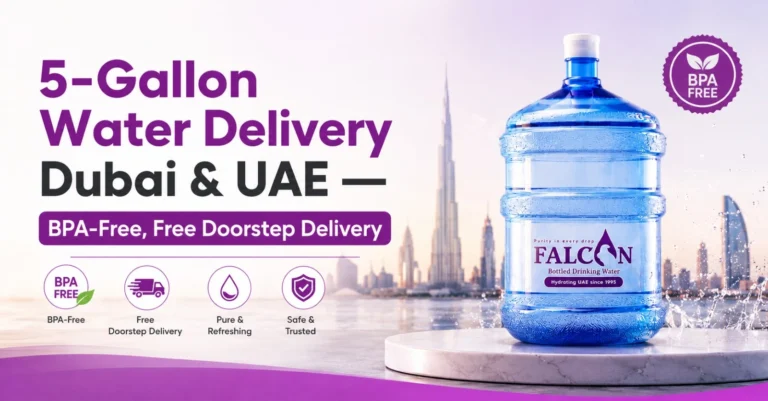
Falcon’s current service page states that its 5-gallon bottles are made from polycarbonate and are BPA-free.
A supplier should be able to provide accurate product information for the specific bottle being supplied.
4. Understand What BPA-Free Means
You may have seen BPA-free on water bottles and packaging.
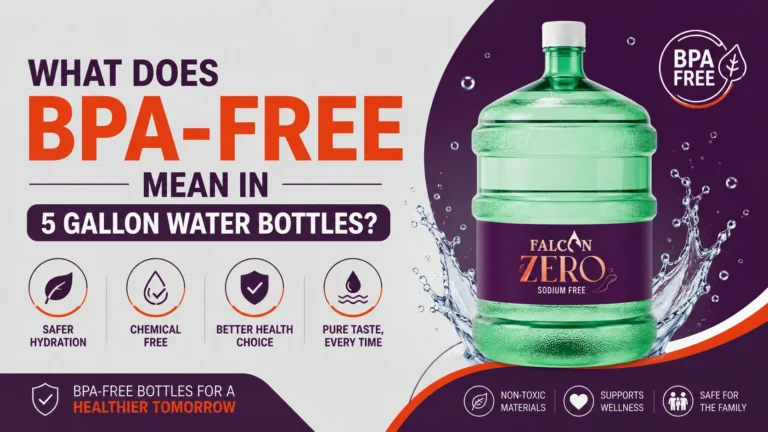
BPA stands for Bisphenol A, a chemical used historically in certain plastics and resins.
When a bottle is described as BPA-free, the statement relates primarily to the container material, not to the purification quality of the water.
That means:
BPA-free bottle ≠ automatically better water
You should evaluate the bottle and water separately:
Bottle
- Material
- Intended use
- Reuse process
- Cleaning
- Handling
Water
- Source
- Treatment
- Testing
- Product information
Both aspects are relevant when choosing a bottled water supplier.
5. Choose the Right Bottle Size
The right size depends on how you consume water.
5-Gallon / 18.9-Litre Bottles
Large-format bottles are commonly used with water dispensers in:
- Homes
- Offices
- Commercial workplaces
- Staff areas
Falcon currently lists 5-gallon / 18.9-litre bottles as its flagship large-format bottled water product and states that they are designed for standard water dispenser use.
1.5-Litre Bottles
These can be practical for:
- Homes
- Meals
- Office use
- Individual consumption
500ml Bottles
Smaller bottles can be useful for:
- Meetings
- Events
- Travel
- Visitors
- Individual servings
250ml Bottles
These may be suitable for:
- Events
- Catering
- Hospitality
- Meetings
The best size is the one that fits your actual consumption and storage requirements.
6. Check How the Bottles Are Handled
For reusable bottles, handling is particularly important.
Ask your supplier about:
- Empty-bottle collection
- Cleaning
- Sanitisation
- Inspection
- Refilling
- Sealing
- Transportation
A typical reusable bottle system may involve:
Collection → Inspection → Cleaning → Sanitisation → Refill → Sealing → Delivery
The exact process varies between suppliers.
The customer’s priority should be knowing how the supplier manages its reusable containers.
7. Review the Bottle Seal and Condition
When receiving a bottle, inspect it before use.
Check:
- Seal condition
- Bottle condition
- Visible contamination
- Cracks
- Damage
- Unusual odour
Do not use a bottle that appears damaged or whose seal appears compromised.
Contact the supplier if there is a concern.
8. Consider How the Water Is Stored
Proper storage matters after delivery.
Follow the supplier’s recommendations, and avoid placing bottled water in unsuitable locations.
Consider:
- Direct sunlight
- Excessive heat
- Contamination
- Physical damage
- Storage near chemicals or strong odours
For large bottles, choose a clean, stable location that is convenient for the dispenser while avoiding unnecessary exposure to heat.
9. Check Delivery Coverage in Dubai
Searching for bottled water usually means you want it delivered conveniently.
Dubai has a large and geographically distributed customer base, so check whether the supplier serves your particular area.
Falcon’s current purified-water page lists coverage across Dubai and names districts including JBR, DIFC, Al Quoz, Deira and Downtown Dubai, alongside wider UAE coverage.
Before ordering, provide:
- Emirate
- Area
- Building or villa location
- Required bottle size
This allows the supplier to confirm the delivery arrangement.
10. Check Whether Recurring Delivery Is Available
Households and offices often consume water regularly.
A recurring schedule can be useful when you know approximately how many bottles you use.
Possible arrangements can include:
- Weekly delivery
- Bi-weekly delivery
- Monthly delivery
- On-demand delivery
- Bulk supply
Falcon currently states that it offers recurring delivery options for homes and businesses, along with flexible quantity adjustments.
The right schedule depends on your actual consumption and storage capacity.
11. Choose a Delivery Plan Based on Consumption
Don’t automatically order the largest available quantity.
Start by monitoring:
Bottles Used → Bottles Delivered → Bottles Remaining
After several weeks, you can estimate your typical consumption.
For an office, consider:
- Number of employees
- Working days
- Visitor traffic
- Meetings
- Number of dispensers
For a home, consider:
- Household size
- Daily consumption
- Cooking requirements
- Guests
- Available storage
This makes your delivery plan more practical.
12. Check Whether the Supplier Supports Offices
Office requirements can differ from household requirements.
A business may need:
- 5-gallon bottles
- Multiple dispensers
- Regular delivery
- Bulk orders
- Adjustable quantities
- Invoice-based purchasing
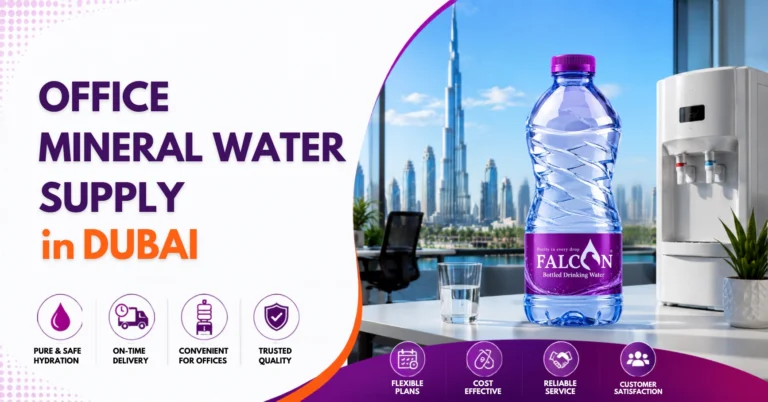
Falcon’s current service page specifically lists office and commercial supply, including bulk orders and recurring delivery arrangements.
When comparing suppliers, ask whether they can maintain a consistent supply as your team grows.
13. Compare Bottled Water Suppliers Beyond Price
Price matters, but it should not be your only comparison point.
Compare:
Water Treatment
How is the water purified?
Product Information
Can the supplier explain what it provides?
Bottle Material
What is the container made from?
Hygiene Process
How are bottles handled and prepared?
Delivery
Does the supplier reliably reach your location?
Flexibility
Can you change quantity or frequency?
Product Range
Are the bottle sizes you need available?
The cheapest quotation may not provide the same product or service.
Purified Bottled Water vs Mineral Water
The two terms are sometimes used interchangeably by consumers, but they describe different concepts.
Purified Water
Water that has undergone a purification process to reduce specified impurities or substances.
Mineral Water
Water associated with a natural mineral composition and source, depending on the product and applicable regulatory definition.
When comparing products, check the specific product description and source information rather than assuming all bottled water is the same.
For Falcon, the current purified-water page specifically positions its purified product around filtration, reverse osmosis and UV treatment.
Is Purified Water Suitable for Homes?
Purified bottled water can be used for household drinking requirements.
Before choosing a supplier, consider:
- Bottle size
- Household consumption
- Storage
- Delivery frequency
- Water dispenser requirements
For larger households, 5-gallon bottles may be practical when used with a compatible dispenser.
For smaller or portable requirements, individual bottles may be more convenient.
Is Purified Water Suitable for Offices?
Yes, bottled purified water is commonly used in office environments.
Office managers should consider:
- Employee numbers
- Dispenser locations
- Daily consumption
- Visitor traffic
- Storage space
- Delivery frequency
A recurring supply arrangement may make water management easier for workplaces with predictable consumption.
What Should You Ask a Purified Water Supplier?
Before ordering, ask:
- What purification process do you use?
- What bottle materials are available?
- Are the bottles BPA-free?
- How are reusable bottles cleaned and sanitised?
- What sizes are available?
- Do you deliver to my Dubai area?
- Can I choose a recurring schedule?
- Can I increase or decrease quantities?
- What quality-control information can you provide?
- Can you support residential and commercial requirements?
These questions give you a clearer basis for comparing suppliers.
Common Mistakes When Buying Purified Bottled Water
Choosing Only by Price
The lowest price does not necessarily represent the same product or service.
Assuming Every Purified Water Product Is Identical
Purification systems and product specifications can vary.
Ignoring Bottle Material
For large reusable bottles, understand what the container is made from.
Not Checking the Seal
Inspect bottles when they arrive.
Buying Too Much
Excess stock can create storage issues.
Buying Too Little
Insufficient supply can lead to frequent urgent orders.
Ignoring Delivery Coverage
Confirm the supplier serves your specific location.
Believing Every Marketing Claim
Look for specific, verifiable information rather than broad claims.
Why Falcon’s Purified Water Is Relevant for Dubai Buyers
Falcon’s current purified-water service describes:
- Five-stage water treatment
- RO purification
- Activated carbon filtration
- UV treatment
- BPA-free 5-gallon polycarbonate bottles
- Dubai delivery
- UAE-wide coverage
- Home and office supply
- Recurring delivery options
For customers comparing suppliers, the important step is still to match the product to their actual needs.
A household may prioritise bottle size and delivery frequency, while an office may need recurring orders and higher-volume supply.
This is why understanding the service details before ordering is useful.
Frequently Asked Questions
What should I check before buying purified bottled water in Dubai?
Check the purification process, product information, bottle material, hygiene practices, bottle size, storage requirements, delivery coverage and supplier documentation.
Is purified bottled water the same as mineral water?
No. They refer to different concepts. Purified water is treated through a purification process, while mineral water is associated with a natural mineral composition and source under applicable definitions.
What is the best bottle size for home use?
It depends on household consumption. 5-gallon bottles can be practical for homes using compatible dispensers, while smaller bottles can suit individual consumption.
Are 5-gallon water bottles reusable?
Some commercial water suppliers use reusable 5-gallon containers. Ask the supplier about its cleaning, sanitisation and return process.
Does BPA-free mean the water is better?
No. BPA-free refers to the bottle material and does not independently determine the quality or purification of the water.
How often should I order bottled water for my office?
It depends on employee numbers, daily consumption, visitors, dispenser usage and storage space. Tracking actual consumption for several weeks can help determine a suitable schedule.
How should purified bottled water be stored?
Follow the supplier’s storage instructions and keep bottles in a clean, suitable location away from unnecessary heat, direct sunlight and contamination.
Does Falcon deliver purified bottled water in Dubai?
Yes. Falcon’s current purified-water service states that it delivers purified bottled water across Dubai and the wider UAE, with named Dubai areas including JBR, DIFC, Al Quoz, Deira and Downtown Dubai.
Does Falcon offer 5-gallon purified water bottles?
Yes. Falcon currently lists 5-gallon/18.9-litre purified water bottles and states that its large bottles are reusable polycarbonate and BPA-free.
Final Thoughts
Choosing purified bottled water in Dubai should involve more than comparing prices.
Before you buy, check:
Purification → Quality Information → Bottle Material → Hygiene → Bottle Size → Storage → Delivery → Supplier Transparency
For homes, the priority may be convenient delivery and the right bottle size. For offices and businesses, recurring supply, dispenser requirements and flexible quantities may matter more.
A clear understanding of the product and delivery service helps you make a more informed decision and choose a supply arrangement that fits your actual needs.