
How to Compare Mineral Water Suppliers in the UAE: TDS, pH & Mineral Content
Choosing between mineral water suppliers in the UAE is not simply about comparing bottle prices or choosing the brand with the highest TDS number. TDS, pH and mineral content can help you understand a water product, but they do not tell the whole story. The water’s source, treatment process, mineral profile, testing practices, packaging and delivery service also matter when comparing suppliers.
For households, offices, hotels, restaurants and other businesses, the better question is not just “Which water has the highest mineral content?” but “Which supplier provides the right product, information and service for my needs?”
This guide explains what to check before choosing a bottled mineral water supplier in the UAE.
Quick Answer: What Should You Compare?
When comparing mineral water suppliers in the UAE, look at these factors together:
- TDS: Shows the total amount of dissolved substances, but it is not a standalone quality score.
- pH: Indicates whether the water is more acidic, neutral or alkaline.
- Mineral profile: Check calcium, magnesium, sodium, potassium and other declared minerals where available.
- Source: Find out where the water comes from and how the source is described.
- Testing and quality control: Look for consistent monitoring and documented processes.
- Packaging: Consider bottle material, sealing and available sizes.
- Delivery: Check whether the supplier serves your location and can maintain the required delivery schedule.
- Product transparency: A good supplier should be able to clearly explain the product rather than relying on vague claims.
What Does TDS Mean in Mineral Water?
TDS stands for Total Dissolved Solids.
It refers broadly to dissolved substances in water, including minerals and salts such as calcium, magnesium, sodium, potassium, bicarbonates, chlorides and sulfates. Because TDS covers a range of dissolved substances, it does not tell you exactly which minerals are present or how much of each mineral the water contains.
This is an important point when comparing bottled water.
A supplier showing a higher TDS number does not automatically mean that its water is better.
Why?
Two waters can have similar TDS levels but noticeably different mineral compositions.
For example, one product could contain more calcium and magnesium, while another could have a different balance of sodium, bicarbonate or sulfate.
So, instead of asking only:
“What is the TDS?”
also ask:
“What is the mineral composition behind that TDS?”
Is Higher TDS Better?
Not necessarily.
TDS is often misunderstood as a simple quality ranking.
It is better viewed as an indicator of the total dissolved material in the water. WHO notes that TDS can influence taste and acceptability, while no health-based guideline value is set for TDS itself.
High TDS ≠ automatically better water
Low TDS ≠ automatically better water
A supplier should therefore be evaluated using the full product profile, not one number printed on a label or website.
For taste-conscious consumers, TDS can still be useful as part of the comparison because dissolved mineral levels influence how water tastes.
What Does pH Mean in Drinking Water?
pH measures how acidic or alkaline water is.
A pH around 7 is neutral. Values below 7 are acidic, while values above 7 are alkaline.
pH is useful when evaluating water because it can affect taste, corrosion behaviour and treatment considerations. WHO materials commonly reference an acceptable drinking-water pH range around 6.5 to 8.5, while also noting that pH itself does not have a health-based guideline value.
The important point is not to assume that:
Higher pH = healthier water
A very high pH should not automatically be treated as a sign of superior bottled water.
When comparing suppliers, look for a reasonable, consistently monitored product rather than marketing claims built around an unusually high pH.
What Is Mineral Content?
Mineral content refers to the individual minerals naturally present in the water.
Common minerals listed on bottled-water labels can include:
Calcium
Calcium contributes to the water’s overall mineral profile and can influence taste.
Magnesium
Magnesium is another naturally occurring mineral found in many mineral waters.
Sodium
Sodium levels can vary significantly between water sources and products, making it useful to check when comparing labels.
Potassium
Potassium may also be present in smaller quantities.
Bicarbonate
Bicarbonate can influence the water’s taste and overall mineral balance.
Sulfate and Chloride
These are also common dissolved components that can contribute to the overall mineral profile.
The exact combination and concentration depend on the source and product.
That is why a mineral profile is more informative than TDS alone.
TDS vs Mineral Content: What Is the Difference?
This distinction is essential.
| Factor | What It Tells You |
|---|---|
| TDS | Overall amount of dissolved substances |
| Calcium | Amount of calcium present |
| Magnesium | Amount of magnesium present |
| Sodium | Amount of sodium present |
| Potassium | Amount of potassium present |
| Bicarbonate | One of the major dissolved ions that can influence taste and balance |
| pH | Acidity/alkalinity of the water |
TDS gives you a broad measurement.
The mineral profile tells you what contributes to that measurement.
Therefore, when comparing mineral water suppliers, a supplier that provides clear product information is easier to evaluate than one that publishes only a single TDS figure.
Why the Water Source Matters
Natural mineral water is not defined simply by having minerals in it.
The Codex definition describes natural mineral water as water distinguished by its mineral and trace-element composition, obtained directly from underground sources, with attention to source protection and consistency of composition.
This makes source information an important comparison factor.
Ask:
- Where does the water come from?
- Is the source clearly identified?
- How is the water collected?
- Is the mineral composition consistent?
- How is the source protected?
- What treatment, if any, is applied?
The word “mineral” should not be treated as a substitute for actual product information.
Does Purification Mean It Is Not Mineral Water?
Not automatically.
The terminology matters.
Purified drinking water is generally water that has undergone a treatment or purification process.
Natural mineral water has a specific meaning linked to its natural underground source and characteristic mineral composition.
Because these are different product categories, consumers should check how a supplier describes the specific product rather than assuming that every bottled-water product is mineral water. UAE regulations distinguish bottled drinking water and bottled natural mineral water as separate categories. This is especially important when comparing suppliers whose product ranges include both purified drinking water and mineral or spring-water products.
What Testing and Quality Information Should You Look For?
TDS and pH are only part of the picture.
A supplier should have a clear approach to quality control and product monitoring.
Look for information about:
Water Testing
Ask whether the water is regularly tested for relevant physical, chemical and microbiological parameters.
Production Controls
Consider how the water is processed, bottled and handled.
Hygiene
Bottle filling, sealing, storage and transportation all matter.
Traceability
A professional supplier should be able to explain how the product is controlled from production through delivery.
Regulatory Compliance
Check whether the supplier states compliance with the applicable UAE requirements for its product category.
The UAE has mandatory standards covering bottled drinking water and natural mineral water, so suppliers should be evaluated in the context of the applicable product category and regulatory requirements.
Why Bottle Material and Packaging Matter
Water quality is not only about what’s in the bottle when it leaves the production facility.
Packaging, sealing, storage and transportation are also part of the overall supply chain.
When comparing suppliers, consider:
- Bottle material
- Bottle size
- Seal quality
- Storage conditions
- Handling procedures
- Delivery conditions
- Availability of refill or exchange systems for large bottles
For offices and homes using large-volume bottles, the bottle itself becomes part of the practical comparison.
Compare Bottle Sizes and Your Actual Requirement
Not every customer needs the same bottle format.
A household may prefer smaller bottles, while an office may need regular 5-gallon deliveries.
Hotels, restaurants and events may have completely different requirements.
When comparing suppliers, look at whether they provide the sizes you actually need, such as:
- Small individual bottles
- Medium bottles
- Large bottles
- 5-gallon bottles
- Event or hospitality formats
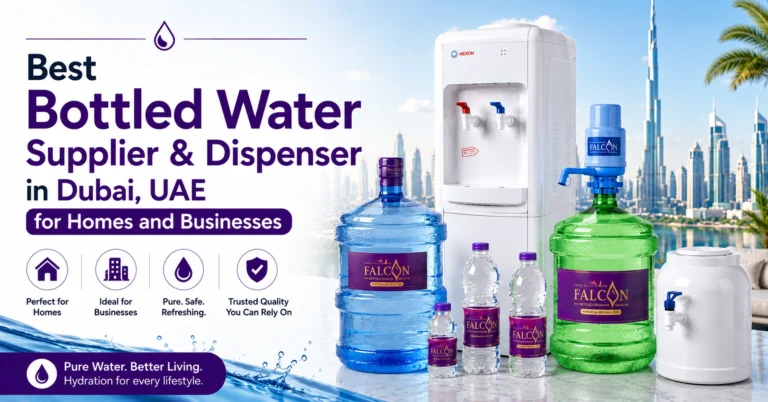
Falcon currently lists multiple bottle formats and delivery options for residential and commercial customers across the UAE. The best supplier is therefore not necessarily the one with the widest product range, but the one that can consistently supply the format and quantity your business or household requires.
Delivery Is Part of Supplier Quality
For recurring bottled-water customers, delivery reliability can be just as important as the product itself.
A supplier may offer suitable water, but if deliveries are inconsistent, it creates problems for homes, offices and commercial facilities.
Before choosing a supplier, check:
Delivery Coverage
Does the supplier serve your emirate and area?
Delivery Frequency
Can you schedule weekly, bi-weekly or other recurring deliveries?
Order Flexibility
Can quantities be adjusted when your requirement changes?
Bulk Supply
Can the supplier handle larger office, hospitality or event requirements?
Response Time
How quickly can you reorder when stock runs low?
Falcon states that it serves customers across all seven UAE emirates and offers delivery arrangements for residential and commercial requirements.
How to Compare Mineral Water Suppliers in the UAE
A simple comparison table can make the decision much easier.
| Factor | Supplier A | Supplier B | Supplier C |
|---|---|---|---|
| Water type | |||
| Source information | |||
| TDS information | |||
| pH information | |||
| Calcium | |||
| Magnesium | |||
| Sodium | |||
| Testing information | |||
| Bottle sizes | |||
| Delivery coverage | |||
| Recurring delivery | |||
| Bulk supply | |||
| Price per bottle | |||
| Customer support |
This prevents you from choosing a supplier based entirely on price.
What Should Matter Most: TDS, pH or Mineral Content?
There is no single number that should decide your purchase.
A useful order of evaluation is:
1. Product type and source
2. Mineral composition
3. Testing and quality controls
4. TDS and pH information
5. Packaging
6. Delivery reliability
7. Price
This approach gives you a much more complete view of the supplier.
For regular household use, convenience and consistency may matter most.
For offices, delivery schedules and bottle sizes can become more important.
For hotels, restaurants and events, volume, packaging and dependable supply may be the priority.
Questions to Ask a Mineral Water Supplier
Before placing a regular order, ask:
Where does the water come from?
Is the product natural mineral water or purified drinking water?
What is the mineral composition?
What are the reported TDS and pH values?
How frequently is the product tested?
What bottle sizes are available?
Do you offer regular delivery?
Do you supply homes, offices and commercial locations?
Can you handle bulk requirements?
A supplier that can answer these questions clearly makes product comparison much easier.
How to Compare Mineral Water Suppliers for Offices
Office water requirements are different from household purchases.
A company may need:
- Regular 5-gallon deliveries
- Multiple water dispensers
- Predictable delivery schedules
- Bulk quantities
- Invoice or account-based ordering
- Flexible quantities during busy periods
- Backup supply for meetings and events
In this situation, the supplier’s logistics and consistency may be just as important as TDS and mineral content.
A slightly cheaper supplier may not be the better choice if deliveries are unreliable or the product information is unclear.
How to Compare Suppliers for Hotels, Restaurants and Events
Commercial hospitality businesses often need bottled water in larger quantities and different formats.
When comparing suppliers, consider:
Bottle presentation
Does the packaging suit your venue?
Available sizes
Do you need smaller bottles for tables or larger formats for back-of-house use?
Bulk capacity
Can the supplier maintain supply during busy periods?
Delivery schedule
Can deliveries be planned around operational requirements?
Consistency
Can the same product be supplied regularly?
Location coverage
Can the supplier deliver where your business operates?
For event organisers, having a supplier that can plan quantities and delivery timing can be more valuable than focusing only on a TDS figure.
Common Mistakes When Comparing Mineral Water Suppliers
Choosing the Highest TDS
Higher TDS does not automatically mean better water.
Comparing Only pH
pH is one parameter, not a complete measure of product quality.
Ignoring Mineral Composition
Two bottles with similar TDS can have different mineral profiles.
Choosing Only by Price
A low price may not include the same packaging, delivery or service level.
Ignoring the Water Source
Source information can help you understand what type of product you are actually buying.
Confusing Mineral Water With Purified Water
These terms can describe different product categories and should not be used interchangeably without checking the product description.
Forgetting Delivery Requirements
For recurring orders, dependable supply matters just as much as the bottle itself.
Final Takeaway
When comparing mineral water suppliers in the UAE, do not make your decision based on a single TDS or pH number.
Look at the complete picture:
Source + Mineral Profile + TDS + pH + Testing + Packaging + Delivery + Price
TDS can help you understand the total dissolved material in water, but it does not tell you exactly which minerals are present. pH provides another useful parameter, but it should not be treated as a standalone measure of water quality. The mineral profile, source information and supplier’s quality-control practices provide much more context.
For households, offices and businesses across the UAE, the right supplier is the one that combines suitable product specifications with transparent information, dependable supply and a delivery service that matches your actual requirements.
Frequently Asked Questions
What is the best TDS for mineral water?
There is no single TDS number that automatically makes bottled water better. TDS reflects dissolved substances and can influence taste, but it is not a standalone health or quality score.
Is higher TDS better for mineral water?
No. A higher TDS only indicates more dissolved material. It does not automatically mean better quality or a better mineral balance.
What pH is suitable for drinking water?
WHO materials commonly reference around 6.5–8.5 as an acceptable drinking-water pH range, but pH alone does not determine overall water quality.
What minerals should I check in bottled water?
Calcium, magnesium, sodium, potassium and bicarbonate are useful components to compare when a supplier provides a mineral profile.
Does TDS show the exact mineral content?
No. TDS is a broad measure of dissolved substances. It does not provide the individual concentration of each mineral. Iris
Is mineral water the same as purified drinking water?
No. Natural mineral water has a specific source and mineral-composition definition, while purified drinking water refers to water that has undergone a purification process. The exact product category should be checked with the supplier.
What should I ask a mineral water supplier before ordering?
Ask about the water source, product type, mineral composition, TDS, pH, testing, bottle sizes, delivery coverage and recurring-supply options.