Bottled Water Supply for Hotels & Restaurants in the UAE: Bulk Orders & Delivery Planning
When comparing mineral water suppliers in the UAE, hotels and restaurants should consider more than the price per bottle. Product selection, bottle sizes, daily consumption, storage capacity, delivery frequency and stock availability all affect how efficiently a hospitality business manages its drinking water requirements. Choosing a suitable commercial bottled water supply service can help hotels, restaurants, cafés and catering businesses plan recurring orders and maintain a reliable supply for guests and staff.
From guest rooms and restaurant tables to buffet areas, kitchens, staff facilities and conference spaces, different departments may need different water formats and quantities. A hotel with several dining outlets, for example, may have a very different consumption pattern from a small café or an independent restaurant.
The key is to develop a supply plan around actual business demand rather than placing orders only when stock runs low.
This guide explains how hospitality businesses across the UAE can estimate their requirements, choose suitable bottle sizes, plan bulk orders, coordinate deliveries and manage inventory more effectively.
Quick Answer: How Should Hotels and Restaurants Plan Bottled Water Supply?
A practical commercial water supply plan should cover these seven areas:
-
Consumption: Estimate daily usage based on occupancy, covers, staff and operating hours.
-
Product selection: Choose suitable bottle sizes for dining, guest rooms, meetings and staff areas.
-
Bulk ordering: Compare quantities, unit prices, minimum orders and commercial terms.
-
Delivery scheduling: Arrange deliveries before stock reaches a critical level.
-
Storage: Allocate suitable space for the planned quantity without obstructing operations.
-
Stock control: Track incoming bottles, current inventory, usage and returns where applicable.
-
Supplier coordination: Confirm delivery locations, time slots, order changes and emergency requirements.
For recurring hospitality demand, a documented ordering schedule is generally more practical than relying entirely on last-minute replenishment.
Why Is a Reliable Bottled Water Supply Important for Hospitality Businesses?
Hotels and restaurants serve customers throughout the day, often across several service areas. Water requirements can change depending on occupancy, reservations, restaurant covers, conferences, seasonal demand and special promotions.
A supply shortage can disrupt normal operations, while excessive ordering can use valuable storage space and tie up working capital.
A planned bottled water supply helps businesses manage several needs at once.
Guest Experience
Guests may expect bottled drinking water in rooms, on restaurant tables, at reception areas or during meetings.
Having the appropriate format available makes it easier for staff to serve guests without searching for additional stock.
Restaurant Service
Restaurants may need individual bottles for table service, takeaway orders, room service or other dining arrangements.
The required quantities can vary significantly between breakfast, lunch, dinner and peak service periods.
Hotel Operations
Large hotels may have separate requirements for guest rooms, staff areas, kitchens, conference facilities and multiple food-and-beverage outlets.
A central purchasing plan can make it easier to coordinate these requirements.
Inventory Management
When usage and delivery schedules are documented, purchasing teams can better identify reorder points, monitor stock movements and reduce avoidable emergency orders.
Budget Control
Bulk purchasing may provide commercial advantages depending on order volume and supplier terms. Comparing the full supply arrangement, rather than only the advertised bottle price, gives purchasing teams a more useful basis for budgeting.
What Types of Bottled Water Do Hotels and Restaurants Need?
The most suitable water format depends on where it will be used, how it will be served and how frequently the stock will be replenished.
1. Small Bottles for Restaurant Tables
Individual bottles can be convenient for table service, cafés, room service and takeaway orders.
When choosing a format, consider serving size, menu positioning, storage requirements and how the restaurant handles unopened bottles.
Small bottles may be suitable where individual portions are preferred, but the right choice depends on the venue’s service model.
2. Bottles for Guest Rooms and Hospitality Areas
Hotels may provide bottled water in guest rooms, suites, reception areas and meeting rooms.
Estimate the requirement according to room occupancy, the number of rooms served, the hotel’s service policy and how often rooms are replenished.
Guest-room consumption should be calculated separately from restaurant and staff usage so that purchasing teams can understand where the water is being used.
3. Larger Bottles for Dispensers
Large-format bottles, such as 5-gallon (approximately 19-litre) bottles, can be useful for staff rooms, back-office areas, selected pantry locations and suitable water dispensers.
This format may be practical where employees need access to drinking water throughout the day.
Before selecting it, check dispenser compatibility, handling arrangements, storage space and the supplier’s empty-bottle return or exchange process.
4. Water for Meetings and Conference Facilities
Hotels that host business meetings, training sessions and conferences may need individual bottles or other suitable water formats.
Estimate these requirements according to attendance, event duration and the venue’s service arrangements. For ongoing hotel operations, keep this demand separate from the property’s regular guest-room and restaurant stock.
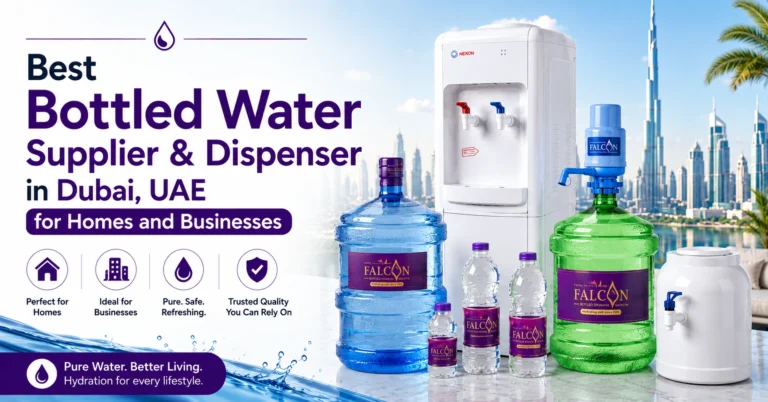
Falcon’s bottled water product range includes several bottle formats for different drinking water requirements. Confirm the current availability, minimum order and suitability of each format before planning a commercial contract.
How to Calculate Bottled Water Requirements for a Hotel
The first step is to break the property’s consumption into operational categories.
Instead of estimating one quantity for the whole hotel, calculate the major demand sources individually.
Step 1: Estimate Guest-Room Requirements
Consider:
-
Number of occupied rooms.
-
Average number of guests per occupied room.
-
Bottles provided per room or guest under the hotel’s service policy.
-
Frequency of room replenishment.
-
Seasonal occupancy changes.
Use your actual operating data wherever possible. Consumption at a business hotel during a conference week may differ from that of a leisure property during a quieter period.
Step 2: Calculate Restaurant Requirements
For each restaurant or dining outlet, review:
-
Average daily covers.
-
Operating days and hours.
-
Bottle format offered.
-
Proportion of orders that include bottled water.
-
Restaurant service style.
-
Expected changes during weekends and peak seasons.
If the hotel operates multiple outlets, calculate the requirements separately before combining them into the central order.
Step 3: Include Staff and Back-of-House Consumption
Staff facilities, kitchens, offices, housekeeping and other operational areas can contribute to overall usage.
Record this demand separately where possible. It can be difficult to forecast hotel-wide consumption accurately if staff requirements are mixed with guest-facing service figures.
Step 4: Include Meetings and Other Activities
Conference rooms, banquets and corporate functions may create temporary increases in water demand.
Use confirmed bookings or historical consumption to prepare estimates. Keep these quantities separate from ordinary daily supply until the delivery schedule is finalised.
Step 5: Add an Appropriate Reserve
Maintain a reasonable reserve to account for fluctuations in demand or unexpected changes in occupancy.
The reserve should reflect storage space, supplier lead time, delivery availability and the consequences of running short. There is no single percentage that suits every hotel.
Example: A Simple Hotel Water Forecast
Imagine a hotel needs to plan its individual bottled-water supply for the next seven days.
| Usage Area | Estimated Weekly Demand |
|---|---|
| Guest rooms | 1,400 bottles |
| Restaurant service | 2,100 bottles |
| Meetings and conference rooms | 350 bottles |
| Staff and operational areas | 280 bottles |
| Total estimated demand | 4,130 bottles |
These figures are illustrative, not industry averages.
The purchasing team would then compare the estimated demand with available stock, confirmed deliveries, storage capacity and any planned increase in occupancy before deciding the final order quantity.
This simple forecast is more useful than ordering based only on the previous week’s total.
How Should Restaurants Estimate Their Bottled Water Orders?
Restaurants can estimate demand using daily covers and the proportion of customers who order bottled water.
A simple planning formula is:
Expected daily covers × estimated bottles per cover = estimated daily bottle demand
For example, if a restaurant serves 180 covers per day and its planning assumption is that 40% of covers involve one bottled-water order, the initial estimate would be:
180 × 0.40 × 1 = 72 bottles per day
For seven days, that would be 504 bottles before adjustments for stock on hand, reserve quantities or changes in demand.
This is only an example. Actual consumption may be higher or lower depending on the menu, customer preferences, service format, weather and operating patterns.
Restaurants should review their own sales and stock records regularly to improve the estimate.
Separate Dining Demand From Other Usage
If a restaurant also supplies takeaway orders, staff facilities or private dining areas, record those requirements separately where practical.
This makes it easier to identify which part of the operation is driving demand and adjust future orders accordingly.
How to Plan Bulk Bottled Water Orders in the UAE
Bulk ordering requires more than multiplying the bottle quantity by the listed price.
Hotels and restaurants should compare the entire purchasing arrangement.
Check the Price Per Bottle and Per Litre
Different bottle sizes can make direct price comparisons misleading.
Compare products on a consistent basis, such as price per bottle of the same volume or price per litre, while considering the intended use.
A smaller bottle may be appropriate for restaurant service, whereas a large-format bottle may serve a dispenser-based requirement.
Confirm Minimum Order Quantities
Ask whether the supplier has minimum quantities for each product format or delivery location.
Minimums may vary between individual bottles, large-format bottles, mixed orders and special packaging arrangements.
Request a Commercial Quotation
For recurring orders, provide the supplier with your expected monthly quantities, bottle formats, locations and delivery frequency.
This gives the supplier enough information to prepare a quotation based on your actual needs.
Review the Full Cost
Consider whether the quotation includes:
-
Product cost.
-
Delivery charges, if applicable.
-
VAT and invoicing terms.
-
Bottle deposits or exchange arrangements where applicable.
-
Any minimum-order requirements.
-
Additional charges for special delivery arrangements.
The lowest headline price is not necessarily the lowest total operating cost.
Confirm How Quantities Can Change
Hospitality demand fluctuates. Ask whether future orders can be adjusted and how much notice is required for quantity or schedule changes.
This is especially useful for seasonal hotels and restaurants with fluctuating covers.
How to Build a Reliable Water Delivery Schedule
A recurring delivery plan should be based on consumption, available stock and supplier lead time.
For example, a restaurant might need deliveries twice a week, while a larger hotel might require more frequent replenishment across several outlets.
The right schedule depends on the operation rather than a universal rule.
1. Choose a Reorder Point
A reorder point is the stock level at which a new order should be placed.
A simple starting formula is:
Reorder point = expected usage during supplier lead time + reserve stock
For example, if a property uses approximately 300 bottles per day and needs two days to replenish its stock, it would need around 600 bottles to cover that lead time, before adding any reserve.
This is an illustrative calculation. Use your actual consumption and confirmed supplier lead time to set the appropriate level.
2. Set Delivery Days
Agree on practical delivery days and time windows.
Consider the hotel’s receiving hours, restaurant schedules, loading access and available storage space.
3. Confirm Delivery Locations
Large properties may require stock at more than one receiving point or operational area.
Confirm where the delivery vehicle should arrive, who will receive the order and how the stock will reach the relevant department.
4. Plan for Peak Demand
Identify busy weekends, conferences, holidays, special menus and seasonal increases in occupancy.
Share major changes with the supplier early so the planned quantity and delivery schedule can be reviewed.
5. Establish a Contingency Process
Decide how the property will respond if stock is lower than expected or a delivery needs to be rescheduled.
Keep the supplier’s contact details and ordering procedure available to the responsible purchasing or operations staff.
How Should Hotels and Restaurants Store Bottled Water?
A good delivery plan should include a practical receiving and storage process.
Once stock arrives, staff should check the quantity, packaging condition and product details before placing bottles into storage.
Use a Suitable Storage Area
Store bottled water in a clean, designated area away from direct sunlight, excessive heat, chemicals and other sources of contamination.
Follow the product’s storage instructions and any applicable food-safety procedures.
Keep Products in Their Original Packaging Until Needed
Maintaining sealed packaging until stock is required helps protect bottles during handling and storage.
Do not issue bottles with damaged seals or packaging that raises concerns about product integrity.
Rotate Stock
Use a first-in, first-out approach where appropriate, while also checking any printed date or storage instructions.
This helps prevent older inventory from remaining at the back of the storage area.
Monitor Temperature and Handling
Storage conditions can affect the practical management of bottled water. Follow the supplier’s guidance and avoid leaving stock exposed to conditions outside the product’s recommended storage requirements.
Separate Stock by Format
Keep individual bottles and large dispenser bottles organised separately. Clear location labels can help staff pick the correct format and count inventory more efficiently.
What Should Restaurants Check When Selecting a Bottled Water Supplier?
The supplier should be evaluated on its ability to support the restaurant’s operational requirements, not just its product price.
Product Availability
Confirm that the required formats are available in quantities that match your expected demand.
Delivery Coverage
Check whether the supplier serves the exact premises and receiving location.
Schedule Flexibility
Find out whether regular deliveries can be arranged and what notice is required to change an order.
Product Information
Clarify the type of bottled water being supplied. If your menu or purchasing specification calls for mineral water, make sure the product is actually described and supplied under the appropriate category.
Do not assume that purified drinking water and natural mineral water are interchangeable product descriptions.
Commercial Terms
Review pricing, payment terms, minimum quantities, delivery charges and bottle-return arrangements where relevant.
Order Support
Establish a clear point of contact for purchase orders, quantity changes, invoice queries and delivery coordination.
Supply Planning
For larger or recurring requirements, ask whether the supplier can discuss an ongoing commercial arrangement rather than treating every order as a separate one-off purchase.
Bottled Water Delivery Planning Across the UAE
Hospitality businesses may operate in Dubai, Abu Dhabi, Sharjah, Ajman or other emirates. Some groups also manage multiple properties across different locations.
A delivery arrangement that works for one property may not automatically suit another because of differences in consumption, receiving hours, storage and access requirements.
For multi-location operations, prepare a location-specific plan containing:
| Information | What to Record |
|---|---|
| Property | Hotel, restaurant or outlet name |
| Location | Emirate and delivery address |
| Bottle format | Required product sizes |
| Expected demand | Daily or weekly estimate |
| Current stock | Available inventory |
| Delivery frequency | Agreed delivery schedule |
| Receiving contact | Responsible staff member |
| Special instructions | Access, timing or unloading requirements |
This creates a shared reference for purchasing, receiving teams and the supplier.
Falcon Bottled Water states that it supplies residential and commercial customers across the UAE, with bulk-order and scheduled-delivery options. Hotels and restaurant groups can discuss their specific property locations, product formats and expected quantities through its commercial bottled drinking water service.
Common Bottled Water Supply Mistakes to Avoid
Ordering Only When Stock Is Nearly Empty
Last-minute orders can create unnecessary pressure on the purchasing team and may not align with available delivery slots.
Using One Estimate for Every Department
Guest rooms, restaurants, events and staff facilities often have different consumption patterns.
Ignoring Storage Capacity
An order may be commercially attractive but impractical if the receiving area cannot safely accommodate the delivery.
Comparing Only the Bottle Price
Product size, delivery costs, minimum quantities and handling arrangements also affect the total cost.
Failing to Track Actual Usage
Without stock records, it is harder to predict demand or understand why consumption has increased.
Overlooking Bottle Exchange Requirements
Where reusable large-format bottles are supplied, confirm how empty bottles should be stored, returned or exchanged.
Not Communicating Operational Changes
Changes in occupancy, restaurant opening hours or conference bookings can influence consumption. Share relevant changes before the next delivery.
How to Reduce Water Stock Waste Without Running Short
Efficient purchasing is about maintaining the right balance between availability and unnecessary stock.
Hotels and restaurants can improve stock control by:
-
Reviewing weekly usage rather than relying only on assumptions.
-
Separating guest-facing demand from staff consumption.
-
Monitoring unopened stock and damaged packaging.
-
Adjusting orders around known occupancy changes.
-
Choosing bottle sizes that suit the service format.
-
Reviewing delivery frequency when storage capacity is limited.
-
Tracking usage and delivery performance over time.
For example, a hotel with stable weekday occupancy may need a different ordering pattern from a resort with significant weekend or seasonal fluctuations.
Use actual consumption data to refine the plan. Avoid reducing reserve stock so aggressively that the operation becomes vulnerable to a delayed delivery or an unexpected increase in demand.
A Practical Checklist Before Placing a Bulk Order
Before confirming the next bottled water delivery, review the following:
Demand
Products
Delivery
Commercial terms
Receiving and storage
This checklist can be reused for each ordering cycle to make purchasing more consistent.
How Falcon Bottled Water Can Support Hospitality Supply Requirements
Hotels, restaurants and other commercial establishments need a bottled water arrangement that fits their actual consumption patterns.
Falcon Bottled Water offers multiple bottled water formats and states that it provides bulk orders and scheduled delivery for commercial customers across the UAE.
When discussing a hospitality supply requirement, prepare the following information:
-
Property location and number of outlets.
-
Required water product and bottle formats.
-
Estimated daily or weekly consumption.
-
Preferred delivery frequency.
-
Storage capacity and receiving hours.
-
Expected seasonal or occupancy changes.
These details help the supplier understand the requirement and discuss suitable quantities, pricing and delivery arrangements.
Explore Falcon’s commercial bottled water supply to discuss bulk orders and a delivery schedule for your hotel, restaurant or hospitality business.
Frequently Asked Questions
How can hotels order bottled water in bulk in the UAE?
Hotels can estimate demand by department, identify the required bottle sizes, check storage capacity and request a commercial quotation based on expected quantities and delivery locations. For recurring requirements, agree on delivery frequency and ordering terms with the supplier.
How do restaurants calculate their bottled water requirements?
Restaurants can use daily covers and the estimated percentage of customers who order bottled water. Reviewing actual sales and stock usage over time helps improve the forecast.
Which bottle sizes are suitable for hotels and restaurants?
The choice depends on how the water will be served. Individual bottles may suit restaurant tables, guest rooms and meetings, while large-format bottles may be useful for suitable dispensers in staff and operational areas.
How often should bottled water be delivered to a hotel?
There is no single schedule for every property. Delivery frequency depends on daily consumption, storage space, supplier lead time and demand fluctuations. Calculate a reorder point based on expected usage during the lead time plus a suitable reserve.
Can hotels arrange recurring bottled water deliveries?
Yes. Commercial suppliers may offer scheduled delivery arrangements. Confirm the available frequency, delivery window, order minimums and process for changing quantities with the supplier.
What should restaurants check before choosing a bottled water supplier?
Review product availability, the exact water category, bottle sizes, bulk pricing, delivery coverage, ordering terms, storage requirements and the supplier’s ability to handle recurring demand.
Is mineral water the same as purified bottled drinking water?
Not necessarily. These terms can refer to different product categories. Hotels and restaurants should confirm the product description and specifications before ordering, particularly if a particular water type is required for their menu or purchasing policy.
How can a hotel avoid running out of bottled water?
Track consumption, set a reorder point, maintain a suitable reserve and schedule deliveries based on actual usage and supplier lead time. Review the plan before busy periods or changes in occupancy.
Can one supplier serve multiple hotel or restaurant locations?
This depends on the supplier’s delivery coverage and commercial arrangements. Businesses with multiple locations should confirm service availability, required quantities and delivery schedules for each property.