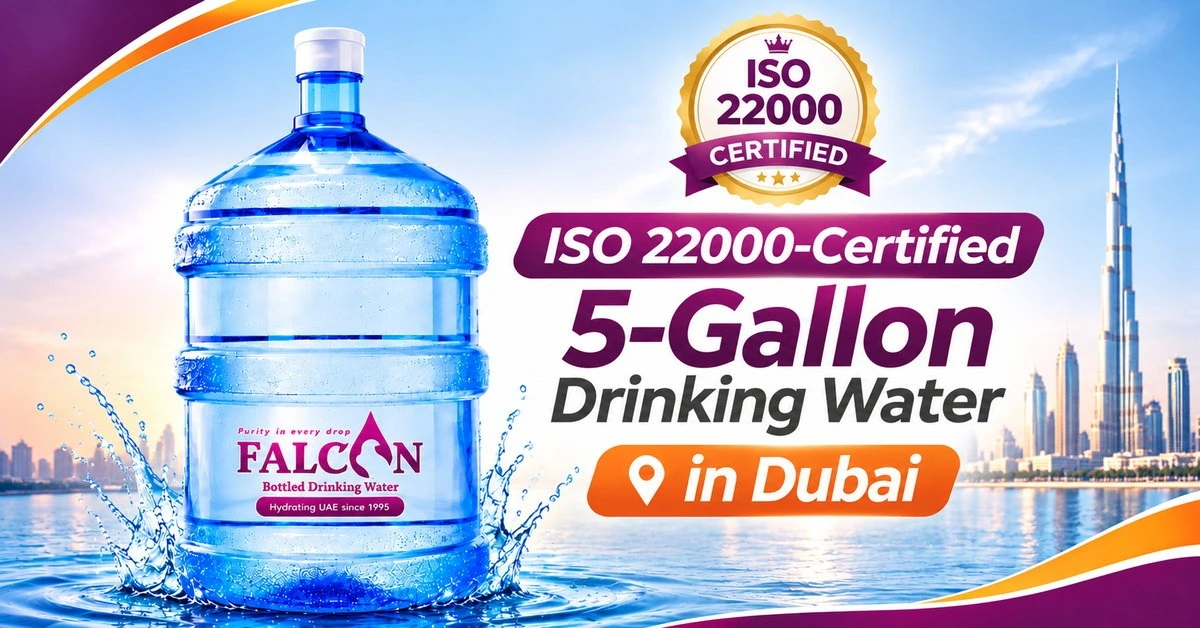
How to Choose ISO 22000-Certified 5-Gallon Drinking Water in Dubai
Choosing 5-Gallon Drinking Water in Dubai involves more than comparing bottle prices and delivery schedules. When ordering large-format bottled water for homes, offices or commercial facilities, customers should also consider the supplier’s food safety management system, water treatment procedures, bottle hygiene, storage conditions and quality-control practices.
One important factor to examine is ISO 22000 certification. This international standard establishes requirements for a Food Safety Management System (FSMS), helping organisations involved in the food chain identify, control and manage potential food safety hazards.
For bottled drinking water suppliers, understanding the certification behind the production and handling process can help customers make a more informed purchasing decision. However, ISO 22000 certification should not be treated as a guarantee that every individual bottle is free from every possible issue. Water testing, hygienic bottling, regulatory compliance and proper storage remain important.
This guide explains how to evaluate an ISO 22000-certified bottled water supplier in Dubai, what certificate details to verify and what to check before ordering 5-gallon (approximately 19-litre) bottles.
1. What Does ISO 22000 Certification Mean for Bottled Drinking Water?
ISO 22000 is an international food safety management standard developed for organisations involved in the food chain.
It provides a structured approach to identifying, preventing and controlling food safety hazards throughout relevant business operations.
For a bottled drinking water company, the food safety management system may cover activities such as:
-
Water treatment and purification.
-
Bottling operations.
-
Packaging and sealing.
-
Equipment cleaning and maintenance.
-
Storage and handling.
-
Transportation and distribution.
-
Monitoring and corrective actions.
ISO 22000 incorporates principles from Hazard Analysis and Critical Control Points (HACCP), along with prerequisite programmes and management-system requirements.
Why Is It Relevant to Drinking Water Suppliers?
Bottled drinking water passes through several operational stages before reaching the customer.
Each stage needs appropriate controls to help manage potential biological, chemical and physical hazards.
For example:
| Production or supply stage | What should be controlled? |
|---|---|
| Water sourcing | Source suitability and applicable quality requirements |
| Treatment | Defined purification and monitoring procedures |
| Bottling | Hygiene, equipment cleanliness and controlled operations |
| Packaging | Suitable packaging materials and proper sealing |
| Storage | Clean and suitable storage conditions |
| Transportation | Appropriate handling and protection during delivery |
| Distribution | Product identification, traceability and customer complaints |
The important point is that ISO 22000 concerns the organisation’s food safety management system. It is not a separate quality certificate attached to every 19L bottle.
Does ISO 22000 Guarantee the Quality of Every Bottle?
No certification should be interpreted as an absolute guarantee about every individual product or future production batch.
ISO 22000 certification provides evidence that an organisation’s food safety management system has been assessed against the standard within its certified scope.
Customers should still consider product testing, regulatory compliance, bottle condition, handling and delivery practices.
2. Check Whether the Supplier Has a Valid ISO 22000 Certificate
One of the most important steps before choosing a supplier is confirming the certification claim.
Some companies mention ISO certification on their websites or promotional materials, but customers may not know which organisation, facility or activities the certificate actually covers.
Ask the supplier for its current ISO 22000 certificate or the details needed to verify it.
Check the Organisation’s Legal Name
The name displayed on the certificate should correspond to the business responsible for the relevant production or supply activities.
This is particularly important when a bottled water brand operates under a larger company or corporate group.
A brand name and the legal entity shown on the certificate may be different. The relationship should be clear.
Check the Certified Facility and Scope
The certificate should identify the activities and locations covered by the food safety management system.
For example, check whether the scope relates to:
-
Drinking water treatment.
-
Water purification.
-
Bottling and packaging.
-
Storage.
-
Distribution, where relevant.
A certificate covering one production facility should not automatically be presented as proof that every unrelated facility or activity within a wider corporate group is covered.
Check the Certification Body
ISO itself does not issue certificates.
Certification is carried out by independent certification bodies. Customers should check who issued the certificate and whether the certification body’s accreditation is relevant to ISO 22000 certification.
Check the Certificate’s Validity
Before relying on a certification claim, examine:
-
Certificate number.
-
Organisation name.
-
Applicable ISO edition.
-
Certified location.
-
Certification scope.
-
Issue and expiry dates.
-
Certification body’s details.
-
Current certificate status.
Where possible, confirm the certificate directly with the issuing certification body or through its official verification process.
A certificate that has expired, been suspended or does not cover the relevant facility should not be presented as current certification.
3. Understand What an ISO 22000 Food Safety Management System Controls
A useful way to assess a bottled drinking water supplier is to understand the practical controls expected within its food safety management system.
The certificate alone does not explain every operational detail. Ask how the supplier manages the following areas.
Water Treatment and Purification
Water treatment is an important stage in bottled drinking water production.
Depending on the source water and product requirements, treatment systems may include:
-
Pre-filtration.
-
Activated carbon filtration.
-
Reverse osmosis.
-
UV treatment.
-
Ozonation.
-
Final filtration and quality checks.
The treatment process can differ between manufacturers. A supplier should be able to explain which processes are used and how their performance is monitored.
Production Hygiene
The production environment should have established procedures for maintaining cleanliness.
Relevant controls may include:
-
Equipment cleaning.
-
Bottling-area hygiene.
-
Employee hygiene practices.
-
Maintenance procedures.
-
Cleaning schedules.
-
Monitoring and corrective actions.
These procedures help control the conditions under which drinking water is handled and packaged.
Monitoring and Corrective Actions
A food safety management system should not simply describe procedures; it should also include monitoring to assess whether controls are working.
For example, when a production check identifies a potential issue, the business should have an established process for recording the finding, investigating its cause and implementing appropriate corrective action.
This is an important part of maintaining consistent operational control.
4. Check Water Quality Testing and Product Traceability
ISO 22000 certification and laboratory testing serve related but different purposes.
A certified food safety management system helps a company manage food safety risks. Laboratory testing provides analytical information about particular water samples or products.
Before ordering, customers can ask the supplier about its water quality monitoring and testing arrangements.
Ask About Microbiological and Chemical Testing
Drinking water testing can involve different parameters depending on the applicable specifications and the source and treatment process.
Examples include:
Microbiological testing: Helps assess the presence of relevant microorganisms or indicators of microbiological contamination.
Chemical testing: Helps evaluate relevant chemical parameters against the applicable drinking-water requirements.
Physical and general quality parameters: Depending on the testing plan, these may include turbidity, appearance, taste, odour, pH and total dissolved solids.
A supplier should be able to explain its testing programme and provide relevant reports or documentation when requested.
Check Whether the Test Report Is Relevant
When reviewing a water test report, look at:
-
Date of testing.
-
Sample identification.
-
Water product or source tested.
-
Parameters included.
-
Laboratory details.
-
Report reference.
-
Results and applicable limits.
A report should relate to the product or sample being discussed. A general certificate or an old report should not automatically be treated as evidence of every future batch’s condition.
Understand Product Traceability
Traceability helps a supplier identify and follow products through relevant stages of production and distribution.
For bottled drinking water, this can involve production records, batch identification, distribution details and procedures for handling customer complaints or product withdrawal.
For customers, traceability is useful because it supports investigation and communication if a product-related concern is reported.
5. Examine the Quality and Hygiene of 5-Gallon Water Bottles
The container is another important part of the bottled drinking water supply chain.
A typical 5-gallon bottle holds approximately 18.9 litres and is commonly marketed as a 19L bottle.
Since reusable bottles may pass through multiple delivery and collection cycles, their condition and handling deserve attention.
Check the Bottle Material
Ask what material is used for the container and whether it is suitable for food and drinking-water contact.
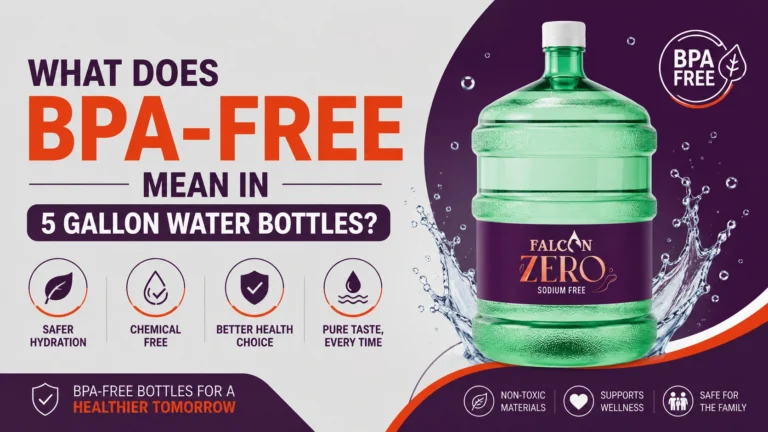
For example, Falcon describes its 5-gallon containers as BPA-free polycarbonate bottles.
Falcon+1
However, BPA-free packaging is a separate consideration from ISO 22000 certification. One does not automatically prove the other.
Check Cleaning and Reuse Procedures
A reusable bottle should be managed through an appropriate inspection, cleaning, sanitising and refill process.
Ask whether the supplier has procedures for:
-
Inspecting returned bottles.
-
Rejecting damaged containers.
-
Cleaning and sanitising reusable bottles.
-
Checking bottle openings and closures.
-
Maintaining hygienic filling conditions.
-
Applying suitable caps or seals.
These procedures matter because the bottle is part of the overall product-handling system.
Inspect the Bottle When It Arrives
Customers can carry out a basic visual check at delivery.
Look for:
-
Cracks or visible damage.
-
Leakage.
-
Broken or disturbed caps.
-
Unusual odours.
-
Visible contamination.
-
Poor packaging condition.
Do not use a bottle that appears damaged or has a compromised seal. Contact the supplier for clarification.
6. Check Storage and Transportation Practices in Dubai
Water quality management continues after bottling.
Storage and transportation are important parts of the supply chain because bottles may be exposed to different environmental conditions between production and delivery.
Suitable Bottle Storage
Customers should store full 5-gallon bottles:
-
Away from direct sunlight.
-
Away from excessive heat.
-
In a clean and dry location.
-
Away from chemicals, fuels and strong odours.
-
Upright and protected from accidental damage.
The supplier should also have suitable storage and handling arrangements before delivery.
Transportation and Delivery Handling
Ask how full bottles are transported and protected before reaching customers.
A supplier’s handling process should consider:
-
Clean transportation areas.
-
Protection from avoidable contamination.
-
Proper bottle positioning.
-
Safe loading and unloading.
-
Appropriate handling of returned empty bottles.
Dubai’s public-health legislation provides for food safety controls and inspection of food-related establishments and activities, including transportation and storage.
This highlights why quality management should extend beyond the treatment and bottling stages.
7. Understand Dubai’s Food Safety Requirements
ISO 22000 certification should not be confused with local regulatory approval or operating permissions.
Dubai’s Law No. 5 of 2025 concerning Public Health includes requirements for food-related activities. Article 21 addresses food permits for activities including the establishment of facilities for the desalination, purification or packaging of water for drinking purposes.
This is separate from private third-party ISO 22000 certification.
When evaluating a bottled water producer, customers and commercial buyers should therefore consider both:
Food safety management certification: Evidence of an assessed management system within the stated certificate scope.
Applicable regulatory authorisation: Relevant local permits and approvals for the business activities and facility.
Neither should be treated as a substitute for the other.
8. Choose the Right 5-Gallon Drinking Water Delivery Arrangement
After checking the supplier’s certification and product-handling practices, consider whether its delivery service suits your requirements.
The best arrangement depends on the number of people using the water, daily consumption and available storage.
Consider Bottle Capacity and Dispenser Compatibility
A standard large-format bottle is designed for compatible water dispensers and pumps.
Before ordering, check:
-
Bottle capacity.
-
Neck and cap compatibility.
-
Dispenser type.
-
Available storage space.
-
Bottle lifting and replacement arrangements.
Select a Suitable Delivery Frequency
Homes may prefer smaller recurring orders, while offices and commercial facilities may need regular bulk deliveries.
Ask whether the supplier offers:
-
One-time orders.
-
Weekly deliveries.
-
Bi-weekly deliveries.
-
Regular scheduled refills.
-
Bulk supply arrangements.
The frequency should reflect actual consumption rather than ordering too many bottles at once.
Clarify Empty-Bottle Collection and Deposits
Reusable bottle programmes may involve refundable deposits and empty-bottle collection.
Before ordering, confirm:
-
Deposit per bottle.
-
Refund or return conditions.
-
Empty-bottle collection arrangements.
-
Damaged-bottle policy.
-
Whether collection is included in regular deliveries.
Clear terms make repeat orders easier to manage.
9. Choosing 5-Gallon Drinking Water in Dubai from Falcon Bottled Water
Falcon Bottled Water is a UAE bottled drinking water supplier serving residential and commercial customers.
According to its official About Us page, Falcon states that its operations are certified to ISO 22000:2018 food safety management standards. The company also describes quality controls covering water treatment, purification, bottling, storage and distribution.
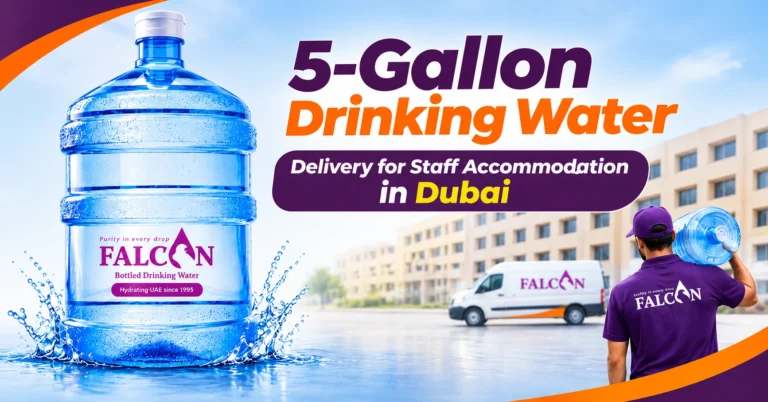
Falcon offers 5-gallon bottled drinking water in approximately 19L containers for homes, offices and commercial establishments. Its bottled drinking water page lists delivery across Dubai, Abu Dhabi, Sharjah and other UAE locations.
What Customers Can Consider
ISO 22000:2018 certification: Falcon publicly states its certification status on its About Us page. Customers making procurement decisions can request the current certificate to review its scope, covered facility, issuing body and validity.
5-gallon bottle options: The company lists large-format bottled drinking water suitable for compatible dispensers.
Water treatment information: Falcon publishes information about its purification processes, including filtration, reverse osmosis and UV treatment.
Residential and commercial delivery: Customers can enquire about delivery schedules based on their location and consumption.
Product and service information: Customers can explore the bottled drinking water range and ask about bottle quantities, dispenser options and repeat deliveries.
Conclusion: Make an Informed Choice When Ordering 5-Gallon Drinking Water in Dubai
Choosing bottled drinking water from an ISO 22000-certified supplier involves looking beyond a certification logo or marketing statement.
Check the certificate’s organisation name, scope, covered facility, issuing body and current validity. Then consider the supplier’s treatment and testing procedures, bottle inspection, cleaning, storage, transportation and delivery arrangements.
Remember that ISO 22000 certification relates to the food safety management system, while water quality testing and local regulatory authorisations provide separate information about the product and the supplier’s operations.
For homes and businesses looking for 5-Gallon Drinking Water in Dubai, Falcon Bottled Water offers approximately 19L bottles and delivery arrangements across the UAE.
Looking for 5-Gallon Drinking Water in Dubai?
Explore Falcon’s bottled drinking water options or contact the team to discuss your preferred bottle quantity and delivery schedule.
Frequently Asked Questions
1. What is ISO 22000 certification for bottled drinking water?
ISO 22000 certification confirms that an organisation’s food safety management system has been assessed against the requirements of the standard within its certified scope. For bottled water businesses, this can cover relevant processes such as treatment, bottling, packaging, storage and distribution.
2. Does ISO 22000 certification guarantee that bottled drinking water is safe?
It provides evidence that the organisation has an assessed food safety management system. However, it does not guarantee every individual bottle or replace laboratory testing, regulatory oversight, hygienic handling and proper storage.
3. How can I verify an ISO 22000 certificate?
Check the certificate’s organisation name, scope, facility, issue and expiry dates, certification body and current status. Customers can contact the issuing certification body or use its official verification process. ISO itself does not issue certificates.
4. How many litres are in a 5-gallon drinking water bottle?
A standard 5-gallon bottle contains approximately 18.9 litres, commonly marketed as a 19L bottle. It is designed for use with compatible water dispensers and pumps.
5. What should I check before ordering 5-gallon drinking water in Dubai?
Check the supplier’s certification, certificate scope, relevant regulatory authorisations, water treatment information, testing procedures, bottle material, cleaning practices, storage conditions and delivery arrangements.
6. Is ISO 22000 the same as HACCP?
No. HACCP is a systematic approach to identifying and controlling food safety hazards. ISO 22000 incorporates HACCP principles within a broader food safety management system that also includes management responsibilities, communication, prerequisite programmes, monitoring and improvement.
7. Does ISO 22000 certification apply to the water bottle or the manufacturing company?
ISO 22000 certification applies to an organisation’s food safety management system within the scope and locations listed on its certificate. It does not mean that each individual bottle carries a separate ISO product certification.
8. Does Falcon Bottled Water have ISO 22000 certification?
Falcon states on its official About Us page that it is certified to ISO 22000:2018. Customers can request the current certificate to check the covered legal entity, facility, scope and validity.
9. Does Falcon deliver 5-gallon drinking water in Dubai?
Yes. Falcon lists 5-gallon bottled drinking water and delivery services for homes and businesses across Dubai and other UAE locations. Customers can enquire about the available delivery schedule and bottle quantities.